Kolossi Medieval Castle

Serving as a fine example of military architecture, Kolossi castle was originally built in the 13th century, and rebuilt in its present form in the 15th century.

After the fall of Acre in 1291, it served as the Grand Commandery of the Knights of the Order of St. John of Jerusalem, and in the 14th century came under the domain of the Knights Templar. During their stay in Cyprus, the Knights produced and exported a sweet wine, which became known as the ‘vin de Commanderie’. Today, Commandaria wine is one of the island’s traditional wines and one of the oldest named wines in the world, having had the same name for eight centuries.

Next to the castle are the ruins of a 14th century sugar mill.

Kolossi Medieval Castle – Audio Guide 

Region: Lemesos (Limassol)
Address: Kolossi, 14km west of Lemesos on the road towards Pafos (Paphos)
Contact No: Tel: +357 25 934 907
Operating Hours: September 16 – April 15, daily: 08:30 – 17:00
April 16 – September 15, daily: 08:30 – 19:30
Operating Period: All year round.
Closed on Christmas Day, New Year’s Day and Easter Sunday (Greek Orthodox).
Entrance Fee: €2,50
For organised groups consisting of more than 10 persons there is a 20% reduction on the entry fees.
The Department of Antiquities can issue special entry cards for all its museums and ancient monuments: One (1) day entry cards – €8,50, three (3) day entry cards – €17,00, seven (7) day entry cards – €25,00.
Website: www.mcw.gov.cy/da
  Opening and closing times as well as entrance fees, are subject to alterations without notice. Visitors are advised to check before visiting.


Agios Nikolaos ton Gaton Convent – St. Nicholas of the Cats Convent

Located on Cape Gata, 15km west of Lemesos (Limassol) and south-east of Akrotiri Salt Lake, the monastery of Agios Nikolaos ton Gaton (St. Nicholas of the Cats) is possibly the oldest monastery in Cyprus. The monastery chapel dates back to the 14th century and was abandoned in the 16th century. It was reinstated by Orthodox nuns in 1983.

According to tradition, the monastery was founded by St. Helena, the mother of Emperor Constantine the Great, who left a piece of wood from the Holy Cross at the site. During that period, Cyprus experienced a severe drought, forcing many people to flee the cape and the area became infested by snakes.

Constantine the Great sent a commander called Kalokeros to Cyprus to release thousands of cats in order to rid the area of the snakes, and thus the cape was saved and came to be known as Cape Gata (Cape Cat).

Whilst the monastery has just a handful of nuns now, there are many cats, which are said to be the descendants of those who rid the area of snakes.

Region: Lemesos
Address: Cape Gata, 15km west of Lemesos.
GPS coordinates: Lat: 34.599653 Lon: 32.987017
Contact No: Tel: +357 25 952 621
Operating Hours*: Daily: 07:00 – 12:00 / 14:00 – 17:00
Operating Period: All year round.
Entrance Fee: Free
  Opening and closing times as well as entrance fees, are subject to alterations without notice. Visitors are advised to check before visiting.

* The monastery’s church is termporaily closed due to technical issues.  The rest of the monastery is open for visiting.

Tamasos Archaeological Site

Tamasos was one of the most important city kingdoms of Cyprus, even though the exact date of its establishment and its founder are not known.

Located on the left bank of the river Pediaios, in the area where the villages of Politiko, Pera and Episkopio are found today, the large archaeological site has unearthed the temple of Aphrodite, two majestic royal tombs, as well as several smaller ones.

Part of the city’s fortifications and copper-processing installations can also be seen at the site, whilst excavations have also brought to light copper workshops associated with Aphrodite – Astarte, and six oversized limestone statues dating back to the 6th century BC, when Cyprus was under Egyptian rule. The latter are now exhibited in the Cyprus Archaeological Museum in Lefkosia (Nicosia).

The Cult of Aphrodite flourished at the site, as indicated by the altar made of rough limestone, as well as various votive vessels, incense burners and lamps that have been unearthed.

The sanctuary and the altar are thought to have been built during the Cypro – Archaic II period (600 – 475 BC), destroyed at the beginning of the 5th century, and again in the 4th century BC, only to have been rebuilt during the Hellenistic period. Terracotta and stone statuettes of pigeons (the bird sacred to Aphrodite) have also been uncovered.

Region: Lefkosia
Address: Politiko village, 21km southwest of Lefkosia
Contact No: Tel: +357 22 622 619
Operating Hours: September 16 – April 15, Monday – Friday: 08:30 – 16:00
April 16 – September 15, Monday – Friday: 09:30 – 17:00
Closed on weekends.
Operating Period: All year round.
Closed on Public Holidays.
Entrance Fee: €2,50
For organised groups consisting of more than 10 persons there is a 20% reduction on the entry fees.
The Department of Antiquities can issue special entry cards for all its museums and ancient monuments: One (1) day entry cards – €8,50, three (3) day entry cards – €17,00, seven (7) day entry cards – €25,00.
Disabled Access: Wheelchair accessible.
Website: www.mcw.gov.cy/da
  Opening and closing times as well as entrance fees, are subject to alterations without notice. Visitors are advised to check before visiting.


Kalavasos – Tenta Archaeological Site

The Neolithic Age settlement of Tenta is situated a short distance from Kalavasos village and dates to 7000 BC. It is one of the most significant Neolithic settlements on the island, and is covered by a characteristic cone-shaped roof, which forms a contemporary architectural intervention in the landscape.

According to local tradition, the name of the site goes back to 327 AD when St. Helen – the mother of Constantine the Great – stayed in a tent (‘tenta’) in this location during her visit to the island following the discovery of the Holy Cross in Jerusalem.
 

Region: Larnaka (Larnaca)
Address: Kalavasos village, 40km from Larnaka, 2,5km off the Lefkosia (Nicosia) – Lemesos (Limassol) motorway.
GPS coordinates: Lat: 34.75254 Lon: 33.30319
Contact No: Tel: +357 24 304 169
Operating Hours: September 16 – April 15, Monday – Friday: 08:30 – 16:00
April 16 – September 15, daily: 09:30 – 17:00
Closed on weekends.
Operating Period: All year round.
Closed on Public Holidays.
Entrance Fee: €2,50
For organised groups consisting of more than 10 persons there is a 20% reduction on the entry fees.
The Department of Antiquities can issue special entry cards for all its museums and ancient monuments: One (1) day entry cards – €8,50, three (3) day entry cards – €17,00, seven (7) day entry cards – €25,00.
Pensioners €1,25.
Website: www.mcw.gov.cy/da
  Opening and closing times as well as entrance fees, are subject to alterations without notice. Visitors are advised to check before visiting.


Kalavasos-Tenta Archaeological Site – Virtual Reconstruction


Royal Chapel of Agia Aikaterini (St. Catherine) – Pyrga village

Considered to be one of the most interesting surviving structures from the Frankish Period on the island, the Royal Chapel was built in 1421 by the Lusignan King Janus.

The building is a small, single-aisled vaulted structure without an apse. In the past a portico enclosed the chapel on all sides (except for the east side). Up to the end of the 19th century, the ruins of a manor house or a monastery attached to the chapel were visible. Today only traces of these survive.

The chapel was originally entirely painted, but many of the paintings were destroyed during the course of time. On the eastern façade, King Janus is depicted in a wall painting, along with his second wife, Charlotte de Bourbon. The couple are kneeling in front of the Crucifixion cross, whilst another figure kneeling by the feet of Jesus at the scene of the Entombment is believed to be Hugh Lusignan, brother of Janus and Latin Bishop of Nicosia (Lefkosia).

Included in the mural decoration of the chapel is a series of coats-of-arms of the Medieval Kingdom of Cyprus, as well as graffiti carved into the frescoed walls. The graffiti belongs to various pilgrims and travellers, and the dates carved with them fall within the period between the 15th and the 16th centuries.

Region: Larnaka (Larnaca)
Address: Pyrga village, 32km from Larnaka, 35km south of Lefkosia, off the Lefkosia – Lemesos (Limassol) motorway
GPS coordinates: Lat: 34.925522 Lon: 33.431892
Contact No: Tel: +357  96 473060 (Mr. George)
Operating Hours: September 16 – April 15, Monday – Friday: 08:30 – 16:00
April 16 – September 15, Monday – Friday: 09:30 – 17:00
Operating Period: All year round.
Closed on weekends and on Public Holidays.
Entrance Fee: €2,50
For organised groups consisting of more than 10 persons there is a 20% reduction on the entry fees.
The Department of Antiquities can issue special entry cards for all its museums and ancient monuments: One (1) day entry cards – €8,50, three (3) day entry cards – €17,00, seven (7) day entry cards – €25,00.
Website: www.mcw.gov.cy/da
  Opening and closing times as well as entrance fees, are subject to alterations without notice. Visitors are advised to check before visiting.


Church of Agios Varnavas and Ilarionas (Saints Barnabas and Hilarion)

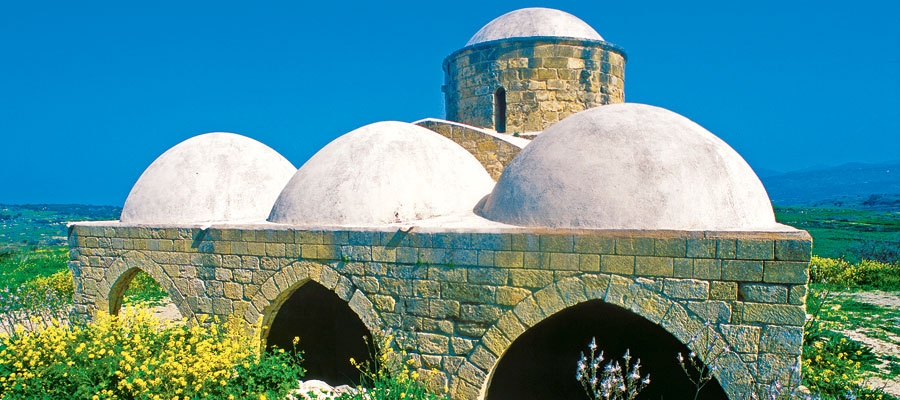
Located in the village of Peristerona, on the west bank of Serrahis tributary river, the church dedicated to Saints Barnabas and Hilarion is thought to have been built in the 9th or 10th century. The five-domed building serves as an outstanding example of Cypriot Byzantine architecture, with part of the original church’s north wall still surviving and incorporated in the western part of the wall of the existing church. The oldest wall-painting samples belong to the 15th and 16th centuries.

Next to the church lies the Turkish mosque of Peristerona, and the image of the two side-by-side has appeared on past currency and stamps as a symbol of peaceful coexistence between Greek and Turkish Cypriots prior to the 1974 Turkish invasion.

Region: Lefkosia (Nicosia)
Address: Peristerona village, Lefkosia – Troodos Road
Contact No: Tel: +357 99 620 753
Operating Hours: Enquire at the coffee shop next door.
Operating Period: All year round.
Closed on Public Holidays.
Entrance Fee: Free
Website: www.mcw.gov.cy/da
  Opening and closing times as well as entrance fees, are subject to alterations without notice. Visitors are advised to check before visiting.


A Stroll in Neapolis, Nemesos, Limassol… Lemesos

Announcement on restarting coming soon

The Walking Tour (City Route) of ‘A Stroll in Neapolis, Nemesos, Limassol… Lemesos’ is designed to acquaint visitors with one of Lemesos’ most important features – the seafront area known as ‘Molos’ or ‘Embankment’.

Traditionally a meeting point for the locals (Lemesiani), this area was turned into an open-air Sculpture Park, which exhibits works of art by Cypriot, Greek and international artists.

The tour also takes participants past the old port, and Lemesos Castle, which is now a museum on the Medieval history of Cyprus. It continues through the surrounding area – home to interesting stone-built warehouses, many of which have become restaurants and exhibition halls.

The walk then visits the sites of Great Mosque or Kepir Mosque, the Cathedral of Agia Napa, the Municipal Market and the traditional shopping centre of Agiou Andreou – now a quaint, pedestrian area.

Start Point: Τourist Information Office, Lemesos (Limassol), Old Port, Syntagmatos Square
End Point: Τourist Information Office, Lemesos (Limassol), Old Port, Syntagmatos Square
Days / Times: Every Thursday at 10:00
Operating Period: All year round.
Not available on Public Holidays.
Estimated Duration: 2 hours, 30 minutes
Booking: Advance booking is required.
Price: Free
Organised by: Lemesos Municipality, Deputy Ministry of Tourism and Cyprus Tourist Guides Association
Information: +357 25362756 please book in advance

Accommodation

Blessed with the beauty of nature’s best palette, the scenery of Cyprus unfolds across glittering coasts, rolling mountains, fragrant forests and rugged headlands. From the warm shores of the mainland to the unspoiled and cool oasis of the Troodos mountain range, nature lovers, artists, photographers and explorers will all delight in meeting shy creatures, and discovering rare plants that peep out amidst waterfalls, coves, woodland, winding trails and secluded sandy beaches. As the island is on the migration path between Europe, Asia and Africa, Cyprus is a birdwatchers dream, with flocks of flamingos frequenting the salt lakes, and many other significant species passing through or nesting. And deep in the forests, the national animal – the Mouflon – roams freely, with catching a glimpse of this timid, wild sheep a real treat for locals and visitors alike. Exotic and rare forms of wildlife also give Cyprus a special touch. Green and Loggerhead turtles breed on the island’s sandy beaches in summer, while the Mediterranean Seal and dolphins have also been seen swimming in the warm, calm, crystal clear seas of the island. Botanists and herbalists will equally appreciate the island’s green side, with a large number of local herbs and endemic plants, including the Cyprus orchid, tulip and crocus waiting to be stumbled upon along winding nature trails and paths less travelled. From stunning sunrise to breathtaking sunset, the natural allure of Cyprus is both magnificent and inspiring… and all waiting to be uncovered.