
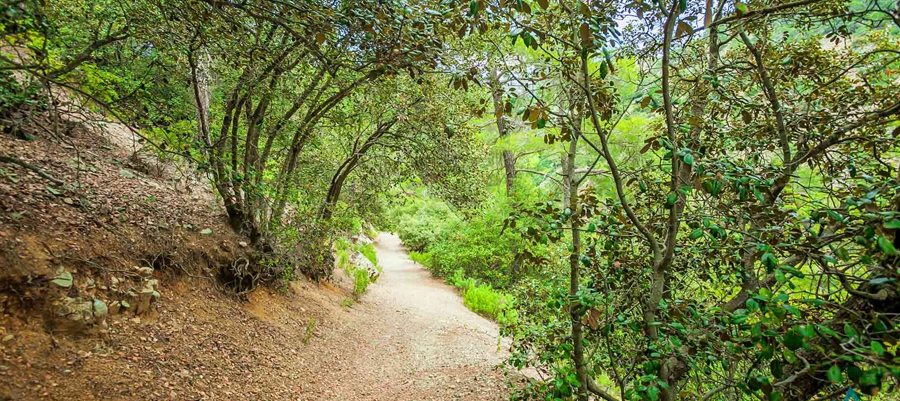
Island Hiking
According to tradition, the best way to really know a place is to walk it. And despite its petite size, the island of Cyprus encapsulates an impressive 10.000 years in its natural environs and diverse landscape that are ripe for exploring and discovering.
With a favourable climate all year round, the great outdoors of the island is easily accessible, and offers a myriad of opportunities to take a journey through nature, history and culture, thanks to the numerous signposted paths and nature trails. A total of 52 designated walking trails have been created to highlight the beautiful landscapes and strong Mediterranean character of the island. By walking them, you can see a treasure trove of varied fauna and flora, as well as the remnants of the island’s mining heritage and other interesting monuments.
Whilst some trails are more challenging than others, they are all a delight for the senses especially in the springtime months, when you can experience the sights, sounds and smells of nature in full bloom, and in all its vibrant glory.
Flora
There are 1.908 different plant species, subspecies, varieties, forms and hybrids that have been recorded in Cyprus to date. This number includes native and alien plants (exotic plants that are naturalized), but excludes cultivated plants. There are 142 endemic plants in Cyprus (found exclusively in Cyprus), which comprise the most important part of the island’s flora. Cyprus’ forests are mostly natural woodlands of great biodiversity and major ecological significance. Many of them have been classified as National Forest Parks and protected areas for flora and fauna, covering more than 70 percent of the NATURA 2000 network of the island.
The Calabrian pine (Pinus brutia) is the main forest tree found from the coastal area until an altitude of up to 1.200 – 1.400 metres, whilst the Black pine (Pinus nigra ssp. pallasiana) dominates in the higher reaches of Troodos.In large rivers and the areas surrounding them, the dominant trees are the oriental plane (Platanus orientalis) and the alder (Alnus orientalis), whilst there are other tree species found on the island on a smaller scale, such as the Cyprus cedar (Cedrus brevifolia) and the Mediterranean Cypress (Cupressus sempervirens).
Bush and shrubland also dominate the landscape. In middle and high elevations, the common bush species of golden oak (Quercus alnifolia) can be spotted on its own, in unmixed forests, or together with pines. In the lowlands you will find maquis shrubland, with dominant species the Phoenician juniper (Juniperus phoenicea), the (wild) olive tree (Olea europaea), the carob tree (Ceratonia siliqua) and the mastic tree (Pistacia lentiscus), as well as the Calabrian pine. Whilst walking along Cyprus’ nature trails you will encounter some of the many endemic plants that are in danger of extinction most of which have been included in the Berne Convention’s list of protected plants. Among these are:
- The skilla a species of plant of the Hyacinthaceae family (Scilla morrisii)
- Loch’s Gloryofthesnow (of Τroodos), (Chionodoxa lochiae)
- Lefkara’s ankle (Astragalus macrocarpus ssp. Lefkarensis)
- Kotschy’s orchid (Οphrys kotschyi)
- The Cyprus tulip (Tulipa cypria)
Fauna
Cyprus also has a wonderful variety of habitats suitable for many species of animal due to the variety of landscapes on the island each with their own particular microclimate and topographical features and the variety of terrains and geological substrates, as well as the diversity of forest and agricultural vegetation.
Among the noteworthy mammals found on the island are:
- The mouflon (Ovis gmelini ophion) a wild sheep species, found only in Cyprus. It is also the largest wild mammal that exists on the island.
- The fox (Vulpes vulpes) Cyprus’ only carnivorous mammal.
- The hedgehog (Hemiechinus auritus dorotheae) an endemic subspecies and a shy and reclusive animal.
- Bats a remarkable feature of Cypriot fauna, and one of the most peculiar types of mammals, with 19 different species found on the island.
Cyprus’ geographical position makes it one of the most important migratory natural habitats and international birdlife organisations consider it among the most important areas in the world for its biodiversity of birds. It is also a unique location in Europe for endemic birds.
The butterflies of Cyprus, which belong to the order leptidoptera, are also considered of particular interest, with 52 species on the island nine of which are endemic to Cyprus.
Sights of Interest
Aside from the natural bounty you will find on the walking trails, some of the routes have been designed to give visitors the chance to discover Cyprus’ cultural heritage through various monuments that include Byzantine churches (UNESCO World Heritage Sites), Venetian bridges, mosques and other interesting sites.
Degree of Difficulty
All nature trails are divided into three categories of difficulty:
- Category 1: Easy trail, with gentle gradient. Suitable for all ages and fitness levels.
- Category 2: Average degree of difficulty, suitable for adults with fairgood fitness levels. Sudden changes in gradient (uphill and/or downhill), and/or course along narrow or rough terrain.
- Category 3: High degree of difficulty. Route with difficult terrain such as sudden changes in gradient (uphill and/or downhill), course along particularly rough and/or slippery, and/or narrow and/or steep terrain. Suitable for adults with very goodexcellent fitness levels. Unsuitable for young children
Find out More!
Summarised information for each of the 31 hiking trails can be found in this section of the website, whilst a more detailed brochure – which includes valuable advice and tips on how to hike safely and comfortably, as well as maps is available to download here. For more detailed information for the full 52 designated trails from the Forestry Department, click here.
404: Page not found
It looks like nothing was found at this location.

Ecclesiastical Museum – Sotira village
Located in the chapel of Saint George in Sotira village, the Ecclesiastical Museum exhibits important religious treasures, such as sacred icons (including one of Jesus Christ from the 15th century), old forms Gospels, liturgical books, crosses, liturgical vessels and others artefacts. It also houses one of only three portable wooden altars of the 16th century that exist in Cyprus.
Next to the museum is the church of Metamorphosis tou Sotiros (Transfiguration of the Saviour). This stone-built, single-aisle, vaulted church was built above the foundations of an earlier Byzantine basilica temple.
The village itself was significant during Byzantine times, which is reflected in the number of old churches there are in the vicinity of the village.
| Region: | Ammochostos (Famagusta) |
| Address: | Sotira village |
| Contact No: | Tel: +357 23 823 932 |
| Operating Hours: | By appointment. |
| Operating Period: |
All year round. Closed on Public Holidays. |
| Entrance Fee: | Free (donations accepted) |
| Website: | www.sotira.org.cy |
| Opening and closing times as well as entrance fees, are subject to alterations without notice. Visitors are advised to check before visiting. |
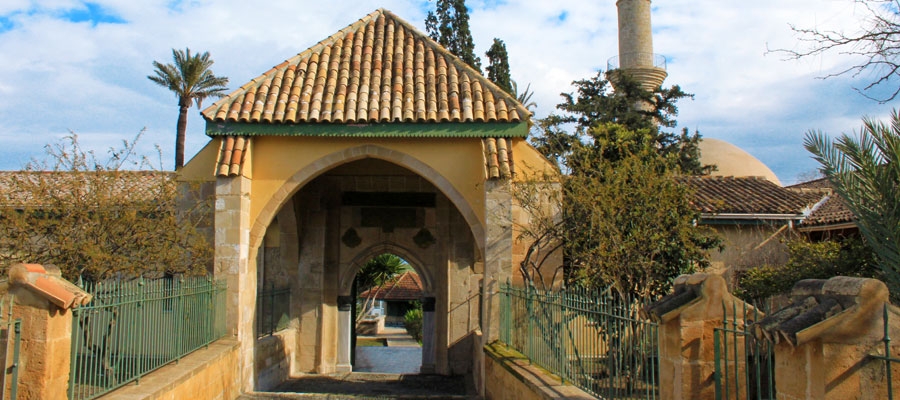
Cyprus the island of Saints (East)
This general route covers the entire eastern part of the island, starting and ending in Lefkosia.
Route: Lefkosia (Nicosia) – Pera Chorio – Kellia – Sotira – Paralimni – Agia Napa – Larnaka (Larnaca) – Dromolaxia – Kisivili – Klavdia – Pyrga – Lefkosia.
On this tour, visitors have the opportunity to view not only churches and monasteries of the Byzantine period and later, but also churches which under turkish rule were converted into mosques.
An interesting and significant place to visit is the Um Haram Mosque, a significant Muslim monument built after the death of Um Haram, who, as tradition has it, was a relative of Muhammed himself.
In Kiti, the church of Panagia tis Aggeloktistis has a mosaic of the 6th century AD. The Monastery of Stavrovouni is a men’s monastery which, according to tradition, was established by Agia Eleni, the mother of Constantine the Great and there lies a piece from the Holy Cross.
Μonuments: Church of Agion Apostolon, Lefkosia – Church of Agios Antonios, Kellia – Churches of Transfiguration (Metamorphoseos) of Agios Mamas, Agios Georgios Chortakion, Panagia Chortakion, Sotira – Churches of Panagia-Agia Anna, and Agia Marina, Paralimni – Monastery of Agia Napa, Agia Napa – Church of Agios Lazaros, Larnaka – Um Haram Mosque or Hala Sultan Mosque, Dromolaxia – Church of Panagia Aggeloktisti, Kiti – Church of Panagia, Kisivili – Church / Mosque Agia Aikaterini, Klavdia – Gothic Church of Panagia Stazousa, Royal Chapel and Agia Marina – Monastery of Stavrovouni, Pyrga.
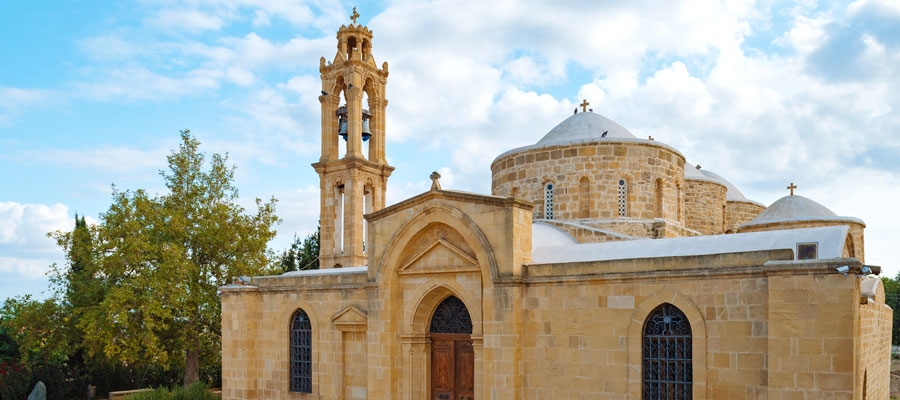
Cyprus the island of Saints (West)
This route is general, which means that it is neither based on cities nor on districts. Heading west, visitors will visit a large number of significant monuments which clearly demonstrate the ecclesiastical wealth of the island.
Route: Lefkosia (Nicosia) – Peristerona – Kalopanagiotis – Κampos – Panagia – Τala – Empa – Pafos (Paphos) / Ktima – Κato Pafos – Geroskipou – Κouklia – Κolossi – Lemesos (Limassol) – Pyrga – Pera Chorio – Lefkosia.
A walk in the greater region will help visitors view various samples of ecclesiastical art, starting from Peristerona and the five-domed church of Agion Varnava and Ilariona. Heading towards Kalopanagiotis, visitors will come across the Monastery of Ioannis o Lampadistis, which is of unique beauty, and where three churches coexist in a single area. Kykkos Monastery is offered for the worship of the icon of Virgin Mary, which, as tradition has it, is a work of Apostolos Loukas.
The course continues towards Pafos and the Monastery of Panagia tis Chrysorrogiatissas, the Egkleistra (enclosure carved out of the mountain) of Agios Neophytos, and the church of Panagia tis Chryseleousas in Empa. When arriving at Pafos, visitors will be able to visit the church of Agia Sofia, which was converted into a mosque under Frankish rule, and in Kato Pafos, the Basilica of Chrysopolitissa – one of the biggest basilicas in Cyprus.
The second and last five-domed church of Cyprus is located in Geroskipou, and is dedicated to Agia Paraskevi, while in Palaipafos – in the village of Kouklia – the church of Panagia tis Katholikis is located very near the ruins of the Temple of Aphrodite, the worship of whom was replaced by that of Virgin Mary.
On the way back to Lefkosia, the route passes from the small church of Agios Efstathios and the impressive Monastery of Stavrovouni, with the strict ritual of Mount Athos, which – according to tradition – is a creation of Agia Eleni.
The wonderfully frescoed church of Agion Apostolon in Pera Chorio, which is the last stop of this route, is an interesting place to visit.
Μonuments: Church of Agion Varnava and Ilariona, Peristerona – Μonastery of Ioannis o Lampadistis, Kalopanagiotis – Μonastery of Panagia tou Kykkou, Κampos – Monastery of Panagia Chrysorrogiatissa, Panagia – Μonastery and Egkleistra of Agios Neophytos, Τala – Church of Panagia Chryseleousa, Empa – Mosque / Church of Agia Sofia, Pafos / Ktima – Palaiochristian Basilica of Chrysopolitissa, Kato Pafos – Church of Agia Kyriaki, Kato Pafos – Agia Paraskevi, Geroskipou – Church of Panagia Katholikis, Kouklia – Church of Agios Efstathios, Kolossi – Μonastery of Stavrovouni, Pyrga – Royal Chapel, Pyrga – Church of Agion Apostolon, Pera Chorio.
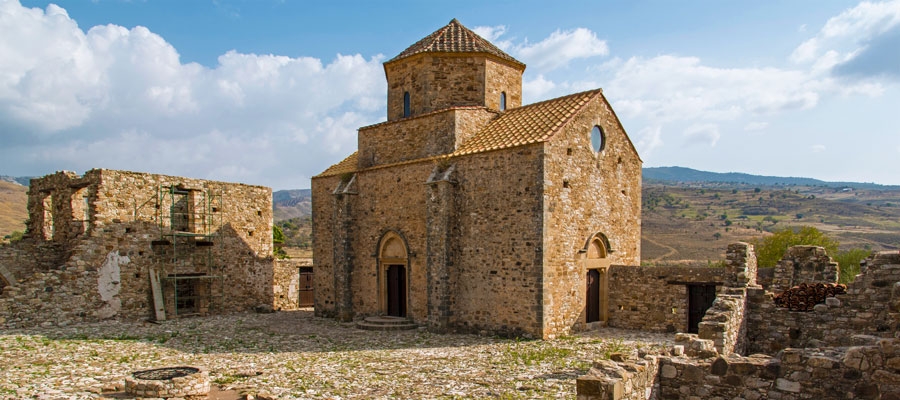
Pafos – The cradle of Christianity in Cyprus (C)
Like in the case of the other routes of Pafos (Paphos), this route also starts from the Palaiochristian Basilica of Chrysopolitissa in Kato Pafos, the church that is connected to Apostolos Pavlos, since in its yard lies the column on which he was tied and whipped.
The Church of Agia Kyriaki, also in Kato Pafos, dates back to the 15th century. Τhe Βyzantine Museum of the Holy Bishopric of Pafos is considered to be one of the richest museums in terms of significant exhibits, and its collection can easily be compared to that of the Museum of the Archbishop Makarios III Foundation in Lefkosia.
The next stop is at the Bishopric and at the Church of Agios Ilarionas, with only the south aisle of the original building salvaged today. The Church of Panagia tis Eleousas in Nata village is a church of large dimensions, which has been under reconstruction in the past years.
The Μonastery of Panagia tou Sinti, in Pentalia is assumed to have been built in 1542. While originally it was autonomous, it later became, under Turkish rule, a glebe of Kykkos Monastery.
The last church of this route is the Church of Agios Nikolaos in Galataria with beautiful frescoes of the first half of the 16th century.
Total route length: 85 km.
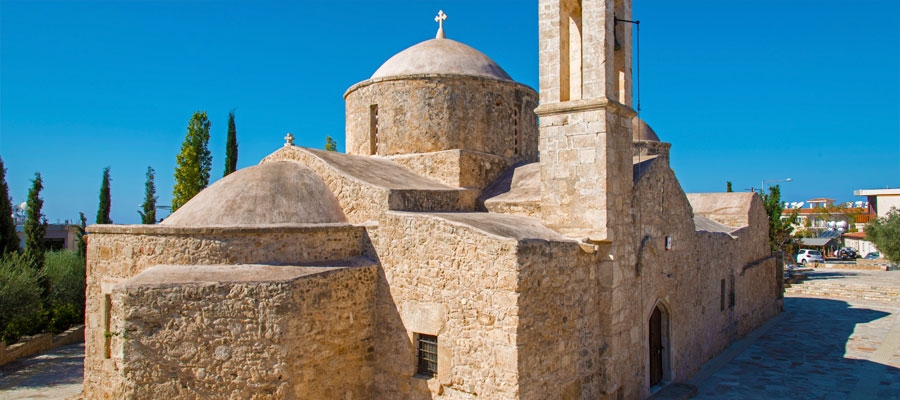
Pafos – The cradle of Christianity in Cyprus (B)
The second ecclesiastical local route of Pafos (Paphos) is longer and starts from Kato Pafos and the Palaiochristian Basilica of Chrysopolitissa, the big church that is directly connected to Apostolos Pavlos, since the column on which he was tied and whipped can be found there.
The Church of Agia Kyriaki, also located in Kato Pafos, is built on the ruins of the north aisle of the Basilica of Chrysopolitissa and dates back to the 15th century. The Holy Bishopric of Pafos hosts the Βyzantine Museum with icons dating back to the 8th, 9th, and up until the 19th centuries.
The next stop is at the Church of Panagia tis Chryselaiousis in Empa, one of the most significant Byzantine monuments of Cyprus. In Tala, the route passes from the Church of Agia Aikaterini, a single-aisled church with a dome, which possibly in its initial form used to be arched. In the same village there is the Μonastery of Agios Neofytos, a Cypriot hermit from Lefkara who left behind a significant work.
The Church of Agia Aikaterini, in Kritou Terra, dates back to the 15th century, and is quite interesting as a church in terms of its architecture. Just before the end of the route, visitors pass from the Church of Agios Andronikos in Polis Chrysochous, which is located on a hill with a wonderful view. The last stop is at the Church of Agios Minas in Neo Chorio at the edges of Akamas peninsula.
Total route length: 85 km.
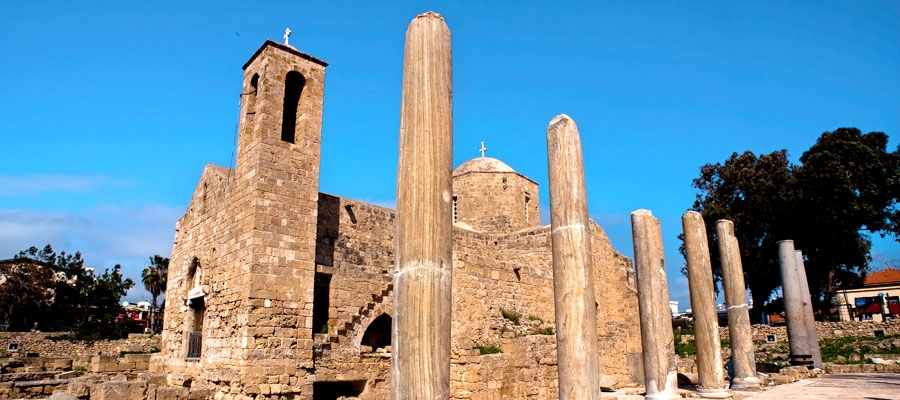
Pafos – The cradle of Christianity in Cyprus (A)
The Pafos (Paphos) area is full of ecclesiastical monuments, with the first on the list being the Palaiochristian Basilica of Chrysopolitissa in Kato Pafos.
This church has yet another reason to constitute an excellent place of interest, thanks to its relation to Apostolos Pavlos; it still houses the column on which, according to tradition, the Apostle was tied and whipped.
In Peristerona, there is the Ecclesiastical Museum, which is hosted by the Archbishopric of Arsinoes, and houses icons and canonicals, as well as other objects from the villages of the area. The Church of Agia Kyriaki was built on the south aisle of the ruined Palaiochristian Basilica of Chrysopolitissa.
In the Holy Bishopric of Pafos there is the Βyzantine Museum whose collection can easily be compared to that of the Archbishop Makarios III Foundation. In Geroskipou, there is the second church of Cyprus with five domes – as well as significant frescoes – which is dedicated to Αgia Paraskevi and, in Acheleia, we find the Church of Agios Theodosios with significant frescoes that date back to the 13th century, one of which depicts the Apostles Petros and Pavlos, along with a portrait of the donors.
The route then passes from the churches of Panagia tis Katholikis in Kouklia, the Hermitage ‘Palaio Egkleistro’ in Souskiou, and ends in Pano Archimandrita and the Hermitage of Agion Pateron.
Total route length: 53 km.
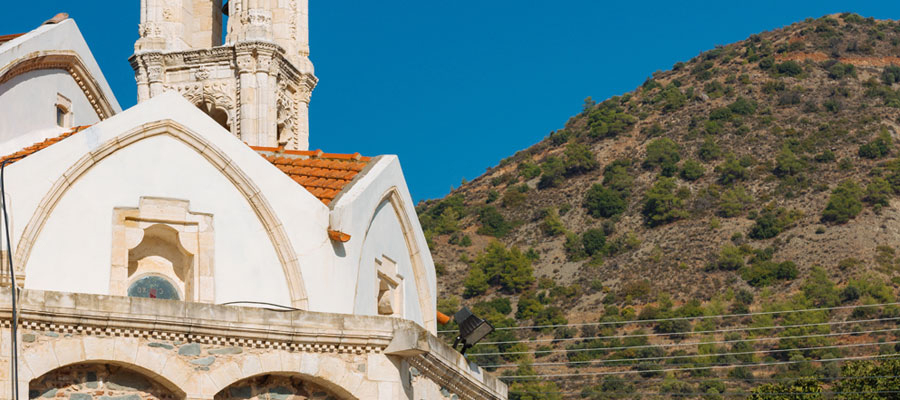
3rd Local Route of Lemesos (Limassol)- Rural
The first stop of this route of Lemesos (Limassol) is in Parekklisia and the Church of Timios Stavros, which houses some very significant frescoes of Italian-Byzantine style. In Kellaki, there is the Church of Agios Georgios with its very interesting wood carved iconostasis – a work made under Turkish rule.
In the Church of Agios Nikolaos, in Klonari, there are wonderful frescoes of the 16th century, and a magnificent iconostasis with very interesting icons that decorate it. In Vikla, there is the Church of Agios Ioannis tou Eleimona, the only building that has been salvaged in this abandoned village. The route then stops at the Church of Agios Georgios tis Akapnou, which is the parish church of the village.
The visit to the Church of Panagia tis Iamatikis in Arakapa is an unforgettable experience. From the inscription, we find out that it was destroyed for some reason, and rebuilt in 1727. In Louvara lies the Church of Agios Mamas, which was built in 1455, although it was decorated 40 years later by painter Philippos Wool.
Total route length: 6 km.