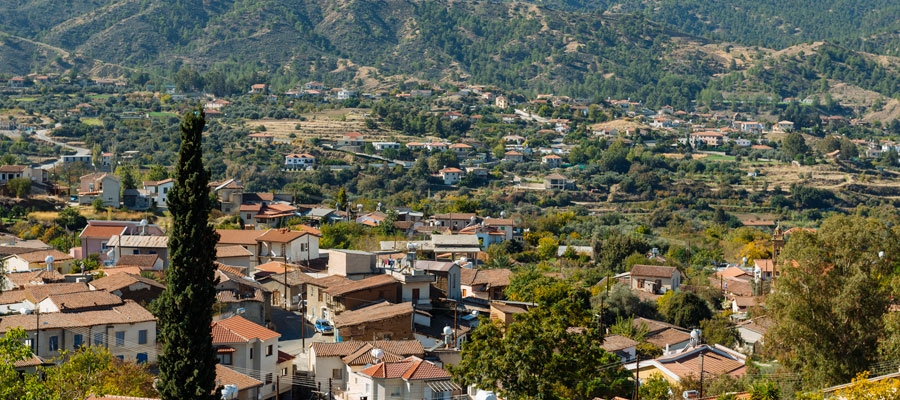
Evrychou village

Located in the Lefkosia (Nicosia) district, the village of Evrychou is the agricultural centre of the Solea region. Located about 50 km southwest of Lefkosia, the village can be reached by following the B10, and then the B9 straight to the heart of Solea Valley.

Its verdant landscape is dotted with small streams that run down the slopes towards the Karkotis Valley, which is lined with rockroses, terebinths, fleabanes, and pine trees. Although the village is a major producer of many kinds of fruit, it is most famous for its apples.

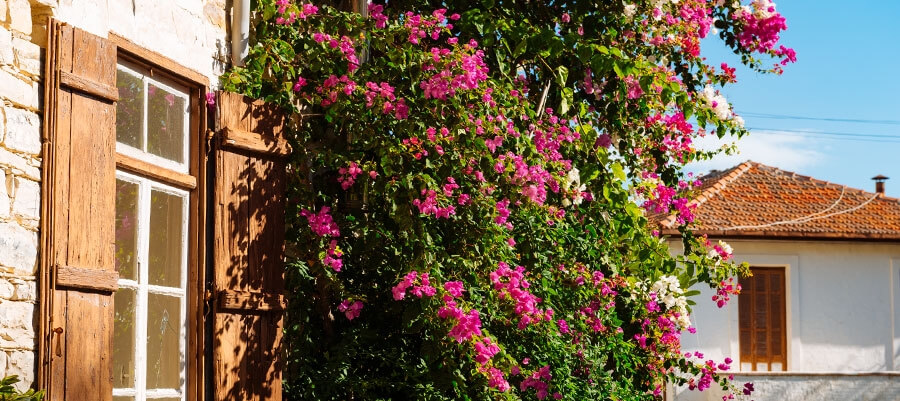
Evrychou retains its traditional character with old houses made of local stone, with tiled inclining roofs and wooden balconies. Amongst its village churches, the most notable are those of Agios Georgios and Agia Marina. The old water mills of the village ‘Mill of Styllis’ are also a must-see, and serve as an excellent example of Cypriot folk architecture.

A unique attraction of the village is the Cyprus Railways Museum, which is housed in the old railway station. Original documents, drawings, photos and various objects related to the now-defunct Cyprus railway system are exhibited, along with scale models of the main stations and rolling stock.
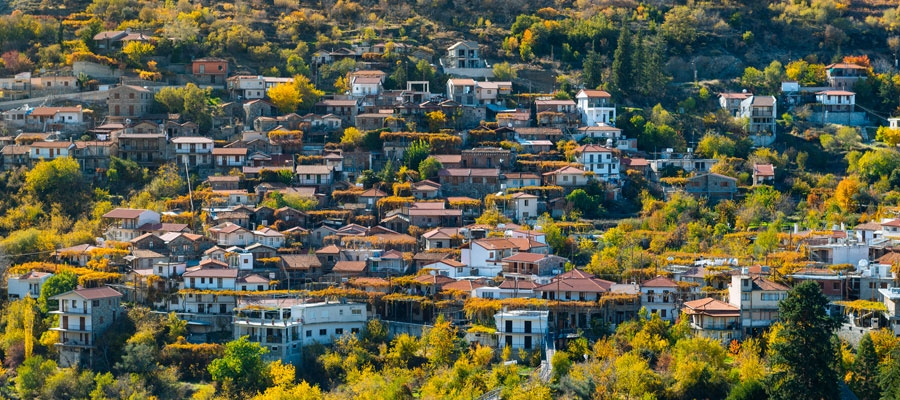
Alona village

Located in the Lefkosia (Nicosia) district, the old village of Alona sits at an altitude of 1.200 metres on the Troodos mountain range, in the picturesque Pitsilia area. Just 53 km away from Lefkosia, the village can be reached by following the E902 route, and then the E903.

The village produces the local spirit ‘Zivania’, and the tradition is celebrated with an annual Festival in November. Visitors can sample and buy Zivania, learn all about its production, and enjoy an entertainment programme, whilst there are also many stalls selling traditional produce.

Interesting sights of the village include two ancient churches; that of Panagia Kardakiotissa – which dates back to the 15th century – and that of Agios Georgios, which houses an exceptional icon of the saint that dates back to 1835. A major celebration takes place annually in the village square in honour of the saint every November 03.

Also, at the village square is the start of a scenic nature trail that unfolds through to orchards of hazelnut and cherry trees. In spring, you will see violets, ferns and even lily pads along the damper areas of the trail, whereas in winter, wild cyclamens dominate the landscape.

The village is naturally beautiful and its leafy scenery provides inspiration for artists, including many greats of modern Cypriot painting.

Pafos (Paphos) City

Legends of love, magnificent mosaics, archaeological awes and captivating coasts make the small town of Pafos (Paphos) enlightening to explore, and beautiful to behold.

Pafos was originally the island’s capital some centuries ago, but can now instead call itself the capital of culture, thanks to its significant historical sites and monuments – many of which are linked to the Ancient Greek Goddess of Love and Beauty – Aphrodite. It is no wonder then that due to its sheer wealth of ancient remnants, Katos Pafos as a whole has been declared a UNESCO World Heritage Site.

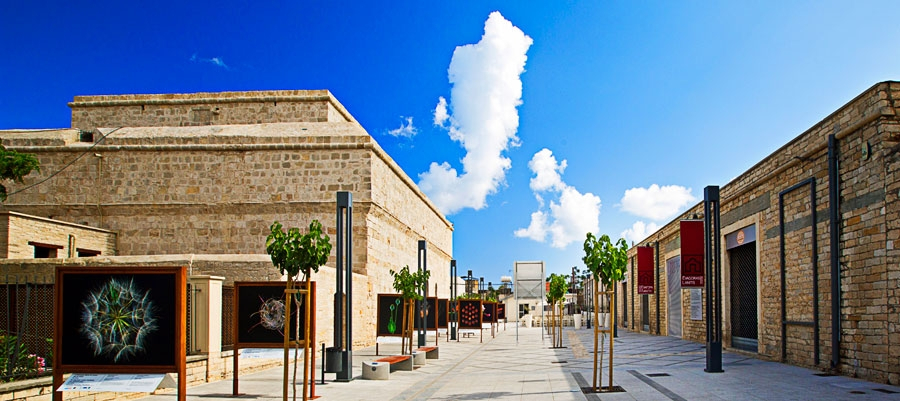
Pafos is comprised of its old and new towns, with its harbour and Medieval Castle forming the focal point. The region also has quaint resorts further afield, including that of Polis Chrysochou and its fishing port of Latchi, and is home to areas of stunning natural splendour, including the Akamas Peninsula and its Avakas Gorge, Lara beach (where Green Turtles nest), and Petra tou Romiou (Aphrodite’s Rock/birthplace).

Although small in size, Pafos is big on the experiences it offers; a fascinating tapestry of modern tourist accommodation, shopping options and entertainment, woven with aspects that are immersed in antiquity and myth… which is why it was Aphrodite’s sanctuary then, and that of visitors the world over now.

Larnaka (Larnaca) City

Beautifully compact, easily accessible and truly authentic, Larnaka (Larnaca) is the island’s oldest soul; the longest continually inhabited region of Cyprus, with a history that dates back 4.000 years. And whilst it is rich in ancient culture, Larnaka is also a thriving and modern European city that offers the best of all worlds.

A characteristic feature of Larnaka is that tourists will find that there is no distinction between resort and town; locals and visitors alike can enjoy the same daily experience of a charming and diverse Mediterranean city. From stretches of varied coastline, a mix of traditional and cosmopolitan establishments and fascinating monuments, Larnaka seamlessly blends its two ‘faces’.

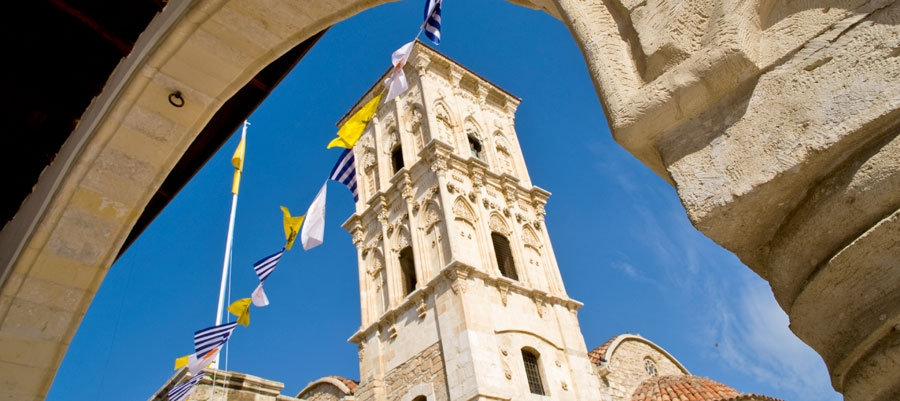
One of its most popular spots is the bustling promenade of Foinikoudes, which is lined with mature palm trees and flanked by beach, eateries and entertainment. Its coast joins with the sea walkway of Piale Pasha – which passes by quaint old neighbourhoods and fresh fish taverns – whilst its parallel shopping centre puts everything at your fingertips, and is home to the grand cathedral church of Agios Lazaros. As the town’s Patron Saint, the story and monument of Saint Lazarus serve as an enduring symbol of Larnaka’s significant religious history.

The town is also the most centrally positioned, offering easy access to other regions, whilst its small and scenic rural villages are famous for their local handicrafts.

For the warmest welcome, and a unique local atmosphere in a progressive town… Larnaka ticks all the boxes!
 

Larnaka Virtual Museums https://larnakaregion.com/larnaka-virtual-museums

360 video guide: https://virtuallarnakaregion.com/cwalk/


Lemesos (Limassol) City

The city of celebrations since ancient times, Lemesos (Limassol) continues its status as the festive centre of the island to this day and is vibrant and lively, yet also provides all the elements for a relaxing beach break, or an unhurried expedition of historical discovery.

From the wedding of Richard the Lionheart and the feasts in honour of ancient deities, to today’s carnival celebrations and Wine Festival, Lemesos has always attracted visitors in their flocks for its exciting events and social revelling.

Its position between two large city-kingdoms of ancient times – Amathous and Kourion – has blessed the area with a significant archaeological status, whilst the town in between is modern and diverse with a range of coastal strips, shopping options, drinking, dining and entertainment.

And Lemesos has the added bonus of being the island’s maritime capital, thanks to its main commercial and business port, and the exclusive, modern marina where both residents and visitors alike can enjoy sea views at one of the many waterfront establishments.

As its rural areas stretch upwards to the mountains, some of the island’s main winemaking villages can be found, giving the Lemesos region its unique link with the age-old tradition of viticulture.

For a voyage of cultural discovery and celebration, combined with sand, sea and mountains, Lemesos offers an experience not to be missed.

lemesos        

Lefkosia (Nicosia) City

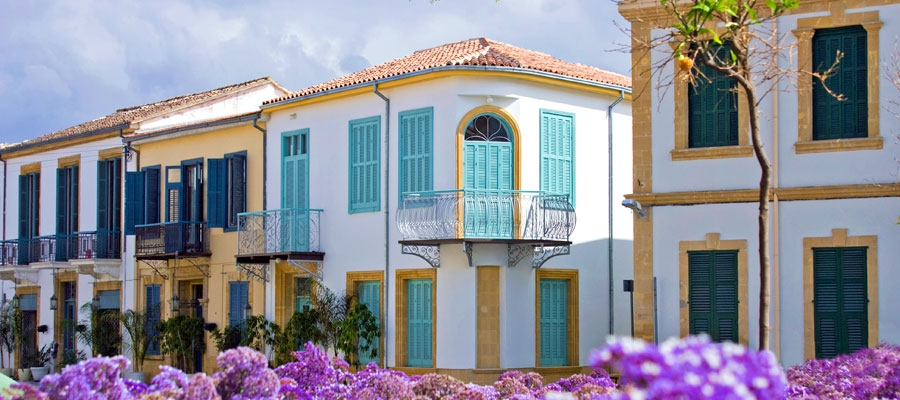
Cosmopolitan, glamorous and bustling, the capital of Lefkosia (Nicosia) is uniquely comprised of an ancient, walled city and a modern, fast-paced metropolis that is the epicentre of the island’s business and commercial activity.

There is no end to the options that Lefkosia provides, blending the current with the traditional. Its retail experience ranges from town centres and malls to traditional shopping quarters of winding streets. Its leisure and nightlife is a mixture of the popular and exclusive, with trendy bars that nestle amidst old, historically rich monuments. A wealth of interesting galleries and museums mix with fun entertainment for all the family. And its selection of cuisine is equally as diverse as its overall character.

All at once, you will be transported back to Medieval times at the ancient city that is surrounded by Venetian walls and heart-shaped bastions, and yet, just a heartbeat away you are undoubtedly in a progressive, European capital.

As you leave the city and enter the rural areas of the region, a different world unfolds; tranquil and picturesque, stretching across countryside and mountain villages, and offering further pursuits such as hiking and cycling in traditional surroundings.

A city always on the go, the many layers of Lefkosia’s various attractions and features make it the island’s capital in every sense.


Troodos Region

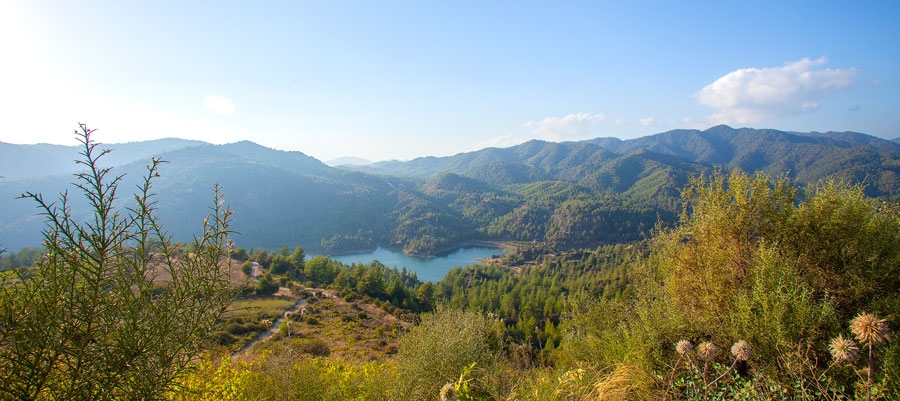
With pine-scented air that feels more invigorating the higher you climb, the Troodos mountain range is the island’s ‘green heart’, and a refreshing oasis that is immersed in endless vistas of forests, valleys and orchards.

Comprised of many different, traditional villages, every twist and turn of the mountain roads leads to something different. The chain of winemaking communities has practiced viticulture for centuries, whilst others are famous for their intricate handmade folk-art, from lace and silverwork to pottery and basket weaving. Agricultural villages known for their different fruit unfold towards others, where waterfalls and springs offer a cooling drink to both human and wildlife.

At its very peak – 1.952 metres above sea level – sits Mount Olympus – whose snowy mounds welcome skiers in winter. And a myriad of natural wealth awaits exploration by foot or bicycle, along paths, over rocks and into woodland, with the villages all welcoming visitors to observe their unique local customs.

Troodos is also religiously significant for its string of 10 UNESCO World Heritage Site Byzantine Churches and other monasteries and chapels. Priceless ancient frescos, fascinating stories of saints, and unique architecture showcase the island’s deep Christian roots.

Whether you want to escape the hot beaches, discover the island’s flora and fauna, or step back in time, the Troodos mountain range is beautifully ideal for a different Cyprus experience.

The Ammochostos (Famagusta) Region

Sparkling, crystal waters and powdery, golden sands are one of the defining features of the region of Ammochostos (Famagusta), with its scenic landscape further dotted by quaint windmills, and its mineral-rich earth growing some of the island’s tastiest, fresh produce.

Comprised of the main holiday resorts of Agia Napa and Paralimni-Protaras, the once-tiny villages have seen their popularity and boundaries expand into bustling resorts that continue to attract visitors in their droves.

The stunning coasts of the region are further enhanced by its famous, vibrant nightlife, large variety of tourist accommodation, idyllic fishing harbours, Medieval churches, and picturesque, traditional villages. Together, they offer the perfect recipe for a fantastic holiday.

One of the main attractions of the area is the Natural Forest Park of Cape Gkreko with its cliffs, caves and coves. Aside from its breathtaking views, the park is ideal for swimming, diving, boat trips, walking and cycling, all in beautiful natural surroundings.

And no doubt, you will taste the difference in the fresh produce that the ‘red soil villages’ (Kokkinochoria) of the region grow. Thanks to its unique richly-red earth, the area is famous for juicy watermelons and strawberries, and the delicious and versatile Cyprus potato, all bursting with flavour!

From sun-seeker to party-animal, foodie to explorer, everyone will fall in love with Ammochostos and its charm.

The Pafos (Paphos) Region

An air of romance and history carries through the naturally abundant and culturally rich region of Pafos (Paphos).

Comprised of its old and new towns, rural villages and picturesque resorts, the region is home to some of the most stunning areas of natural beauty on the island, whilst its many archaeological sites are historically invaluable, with Katos Pafos declared a UNESCO World Heritage Site as a whole.

Centered around the quaint harbour and impressive Medieval Castle, Pafos’ environs then stretch to incorporate the tourist resort of Polis Chrysochous. The pretty and tranquil area – known simply as ‘Polis’ – has expanded to become a sub-district in its own right, and encompasses the beautiful Akamas National Park, Lara beach – which is a breeding site for turtles, and the traditional fishing shelter of Latchi.

Whilst visiting the area, pass by the Baths of Aphrodite, which is located near Polis. Greek mythology tells that the Goddess of Love and Beauty bathed here, and it is one of the enticing sites in the region that trace her story. Her connection with Cyprus begins at the landmark rock formation of Petra tou Romiou (Aphrodite’s Rock/birthplace), where  she rose from the waves. From there, make a pilgrimage to her sanctuary at Kouklia.

Further out, the monastery of Agios Neofytos is located in a secluded valley, and was founded by the Cypriot ascetic Saint Neofytos around 1200. The monastery of Panagia Chrysorogiatissa, next to Panagia village, is also significant for its well-preserved buildings dating back to 18th century.

Nestled within Pafos Forest is the breathtaking mountain locality of Cedar Valley. The area is crossed by a country road that unfolds into Stavros tis Psokas, an additional mountain locality that is home to the rare and shy Mouflon (Ovis gmelini ophion).

A myriad of outdoor pursuits can also be enjoyed, further enhanced by religious monuments, wineries and museums, making the Pafos region a haven of nature and culture.

The Larnaka (Larnaca) Region

East meets west in the ancient district of Larnaka (Larnaca), where hundreds of years of contrasting civilizations, architecture and culture have left their mark on an authentic and diverse region.

Both Christianity and Islam have important religious sites in Larnaka. The Church of Agios Lazaros, who lived in Larnaka after his resurrection, and the Mosque of Hala Sultan – built in honour of the Prophet’s Mohammed’s aunt – are two of the main attractions of the city. Other popular sights are the Medieval Castle, the palm tree-lined promenade of ‘Foinikoudes’, and Larnaka Salt Lake, which fills with flocks of vibrant pink flamingos during the winter months.

Further out, the mountainous areas of Larnaka trail up the Troodos range, which is dotted with charming villages of narrow streets, where traditions and skilled handicrafts are still practiced. Of the most famous is the handmade lace embroidery of Lefkara and its delicate filigree silver, whilst villages like Kato Drys, Vavla and Odou are also pretty and tranquil.

The region is also rich in significant archaeological sites, including ‘Choirokoitia’ – one of the best-preserved sites of a prehistoric settlement in the Eastern Mediterranean – and ‘Kalavasos Tenta’, located in the rural areas.

One of the finest examples of Byzantine art of the Justinian period – a rare 6th century mosaic of the Virgin and Child between two archangels – can be found in the region at Angeloktisti Church in Kiti village, whilst the solitary monastery of Stavrovouni, one of the oldest on the island, sits perched on a rocky peak with panoramic hillside views. In Pyrga village, the Royal Chapel – built in 1421 by the Lusignan King Janus – is  decorated with an interesting wall painting of the king and his wife, Charlotte de Bourbon.

Enjoy a melting pot of diversity and history, combined with coast and mountains in the captivating region of Larnaka!