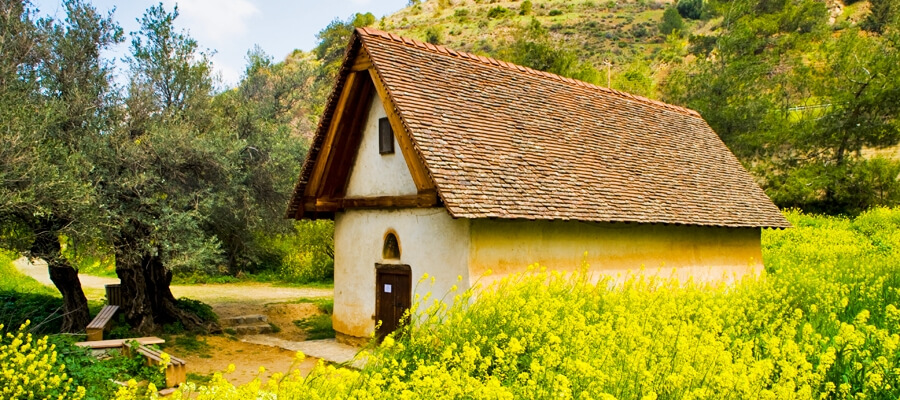
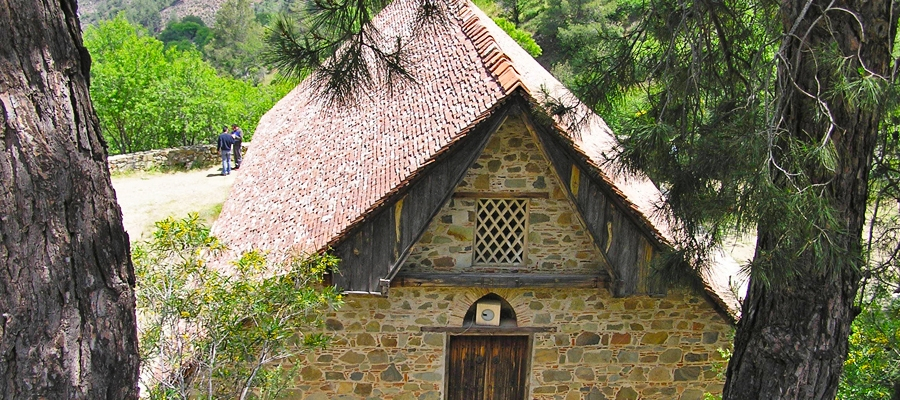
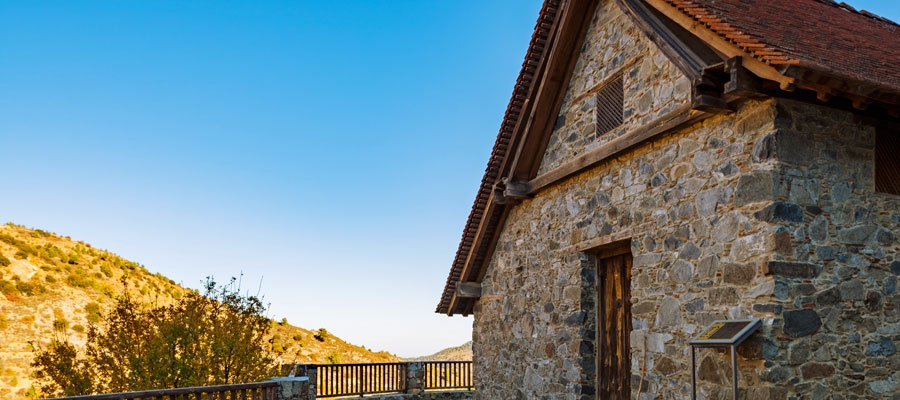
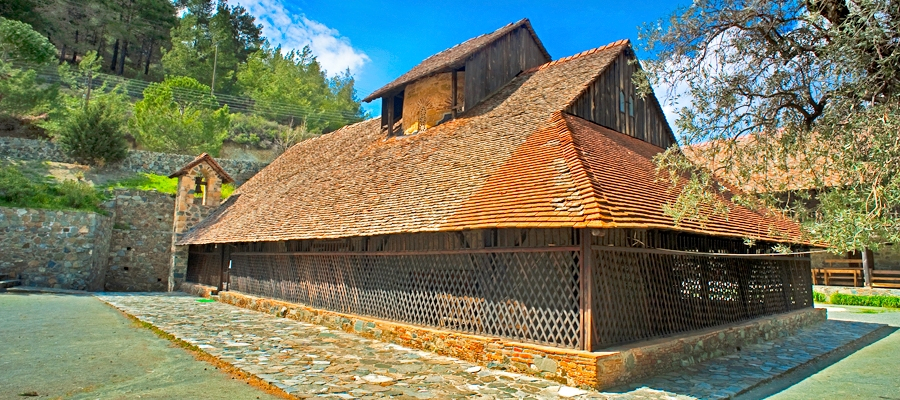
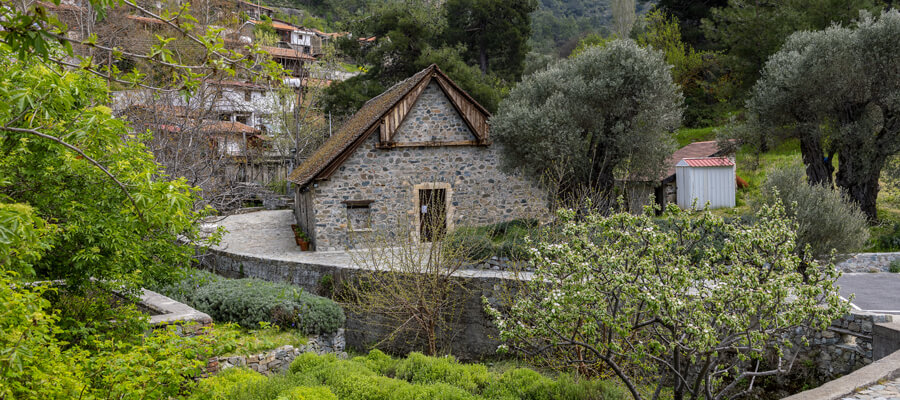
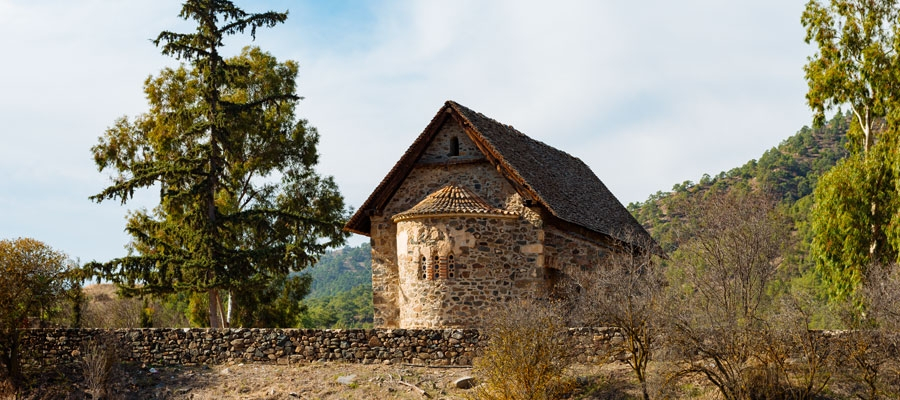
Located in the mountainous village of Galata, the Church of the Archangelos Michael, or Panagia Theotokos, is a timber-roofed chapel, painted in the post- Byzantine style of the early 16th century and one of four painted churches in the village.
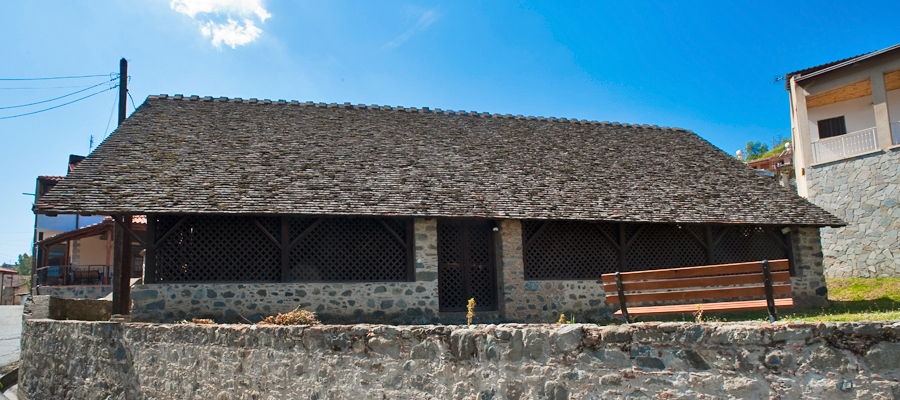
Located in the centre of the mountainous village of Galata, the church of Agios (Saint) Sozomenos dates to the early 16th century and retains a complete series of frescoes in the post-Byzantine style. It is one of four painted churches in the village.
According to an inscription above the west entrance, the church was built and decorated in 1513, and 14 villagers undertook the financial responsibility of painting the church. The structure is aisle-less and timber-roofed, with the roof extending to form a portico in the shape of the Greek letter ‘pi’ (like a square ‘u’).
The church’s interior is covered with frescoes that are in generally good condition and are divided into two tiers. On the upper tier there are scenes from the Christological cycle, while on the lower tier the standing figures of saints are depicted under painted arches. In the apse of the bema, the Virgin Mary is shown between the Archangels Michael and Gabriel. The wall paintings on the external side of the north wall include scenes from the Second Coming, the Root of Jesse and the eight Ecumenical Synods.
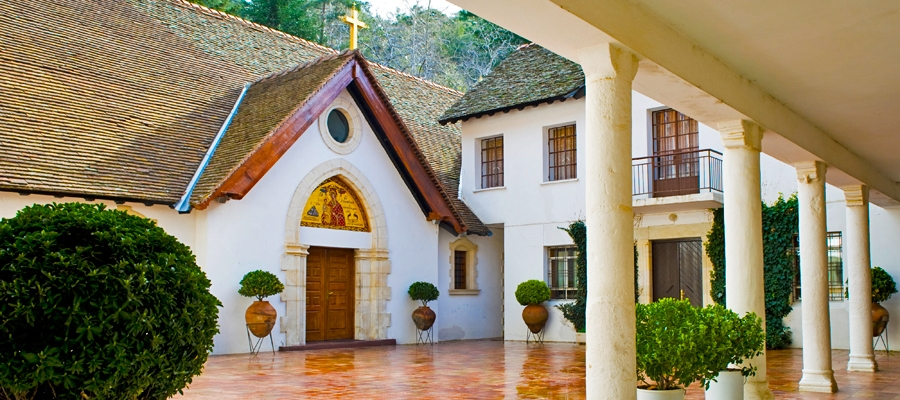
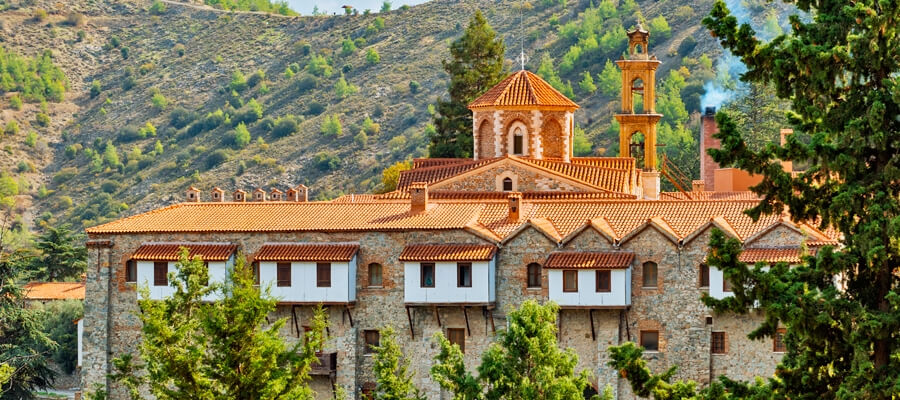
Located on the southern slopes of the Troodos mountain range, the 13th century Trooditissa Monastery is situated among pine trees, commanding a picturesque spot. The present church was built in 1731 and contains a priceless silver-leaf covered icon of the Virgin Mary brought from Asia Minor, believed to give childless couples hope if they pray to her.
The exact date of the foundation of the monastery is not known, but it is believed to have been established immediately after the iconoclastic era by a hermit who resided there during the years of the iconoclasm. The church, as well as the monastic buildings, belong to a later period and can be dated to the end of the 18th or the 19th and 20th centuries.
The monastery is a retreat for prayers, and as such it is closed for visits, although the church is open to visitors.
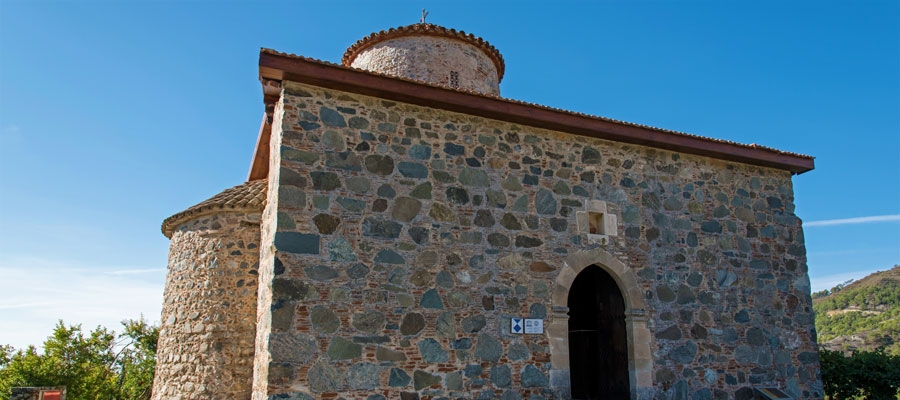
The 14th century church of Timios Stavrou (Holy Cross) in Pelendri village is decorated with exquisite wall paintings of the Palaiologan period and is a UNESCO World Heritage site.
The church was originally a single-aisled domed structure, built around the middle of the 12th century, and may have been the church of a cemetery. It was destroyed under unknown circumstances, and the present form of the church is the result of several additions and alterations, carried out throughout various periods, with only the original apse surviving.
According to an inscription in the apse, the original wall paintings date to 1171 / 1172 with fragments of the decoration preserved on the apse under the layer of the 14th century frescoes. The main part of the church was decorated during the second half of the 14th century by at least two artists.
The north aisle served as a private chapel for the family of the Latin feudal lord of the area, Ioannes Lusignan (1353 – 1374 / 1375), and the village itself was once the property of Jean de Lusignan, son of the Lusignan King of Cyprus, Hugh IV.
Located about 3km outside the mountainous village of Platanistasa, the 15th century church of Stavros tou Agiasmati is a UNESCO World Heritage site and retains the most complete cycles of mural paintings of the second half of the 15th century on the island.
Its name derives from the word ‘Agiasma’ (-atos) which in Greek means ‘sanctified water, spring or well near a church’. The church used to be a monastery church, but only traces of the cells of the monastic buildings remain to the south of the church.
The surviving structure is a single-aisled building with a steep-pitched timber roof covered with flat tiles that extends beyond the main structure to form a portico on all four sides – a feature that is unique in Cyprus. According to an inscription, the building was built with the donation of a priest named Petros Peratis and his wife Pepani, who are both depicted on a fresco offering a model of the church to Jesus with the mediation of the Virgin. Also noteworthy is the extensive and multi-person Last Judgment scene, which unfolds up to the far end of the gable where Jesus Christ is depicted.
Whilst the year of the church’s erection is not known, it is generally accepted that its decoration was completed in 1494.
Located in the mountainous region of Moutoulla, the tiny 13th century chapel of Panagia tou Moutoulla is one of the earliest examples of its type and is a listed UNESCO World Heritage Site.
The church has a steep-pitched timber roof and frescoes dating to 1280. The narthex was added at a later stage, after the beginning of the 16th century, and extends to the west and north sides of the church. The timber roof also covers the narthex. The wall paintings are the only series of the thirteenth century (1280) that survive in Cyprus and can be dated with precision.
The church was built and decorated through the donations of Ioannis of Moutoullas and his wife Irene, who are both depicted holding a model of the church. It is believed that it may have been a private chapel.
The village itself has an ongoing tradition for carved wooden basins.
Located in the mountainous area of Pitsilia, between the villages of Lagoudera and Saranti, the 12th century church of Panagia tou Araka is a listed UNESCO World Heritage site and is considered to be of the most important Byzantine period churches on the island.
The church used to be a monastery church, built during the second half of the 12th century, when monastic life was flourishing in Cyprus. It survived until the first decades of the 19th century and its remains include a two-storey monastery building to the north, along with the church.
The church is a single-aisled domed structure with a cross-shaped, steep-pitched roof that extends to form a latticed-woodwork portico. During the 18th century, the west wall was demolished and the church was extended.
The frescos inside the church are comparable to those prevailing throughout Greece, the Balkans and Russia, and were painted by the artist Theodoros Apsevdis in the late Comnenian style (1192). Those in the apse of the bema are of a different style to those in the rest of the church, and it is believed that they were painted by another artist before 1192.
Located in the Solea Valley, in the village of Kourdali, the church of Panagia Chrysokourdaliotissa was built in the 16th century as a monastery church dedicated to Panagia (the Virgin Mary), and according to the foundation stone, was established by deacon Leone Kourdalis.
The preserved church is three-aisled, with a steep-pitched roof and flat roof tiles. The aisles of the church are divided from the nave by wooden arcades. The church contains wall paintings and icons of the 16th century in the Italo-Byzantine style, and the iconostasis is a fine example of wood sculpture of the 16th -17th centuries.
In 2006, the Holy Synod decided to re-establish the Monastery.
Region:
Troodos area [Lefkosia (Nicosia) district]
Address:
Kourdali village
Contact No:
Tel: +357 99 770 592
Operating Hours:
Daily: 08:00 – 13:00 / 16:00 – 19:00
Operating Period:
All year round.
Closed on Public Holidays.
Entrance Fee:
Free
Opening and closing times as well as entrance fees, are subject to alterations without notice. Visitors are advised to check before visiting.
Located on the east bank of a stream, 3km from the mountainous village of Nikitari, Panagia Asinou Church is a small church dedicated to the Virgin of ‘Phorbia’. It is a UNESCO World Heritage Site and contains some of the finest Byzantine wall paintings on the island, dating from the 12th to the 17th century.
The church used to be a monastery church that was built in 1099 with the donation of Magistros Nikephoros Ischyrios, who subsequently became a monk with the name Nikolaos. It functioned until the end of the 18th century, when it was abandoned.
The church consists of two parts – the vaulted single-aisled nave and the narthex – which is a later addition belonging to the second half of the 12th century. The 12th century steep-pitched timber roof, covered with flat tiles, sheltered the church. Today, there are no traces of the rest of the monastic buildings.
The murals inside the church date from the 12th century to the 17th century and reflect the art of Constantinople, which is thought to be the artist’s birthplace.
Located on the slopes of Kionia, in the valley of Machairas mountains, Machairas Monastery is one of the three Royal and Stavropegic of the island and houses the miraculous icon of Panagia (the Virgin Mary) of Machairas, which is attributed to Agios Loukas (Apostle Luke) the Evangelist.
According to tradition, an unknown hermit sneaked the icon into Cyprus during the iconoclasm years (between the 8th and 9th century AD) and kept it in his cave until his death. Blessed with the divine grace, the hermits Ignatios and Neophytos around 1145, discovered the cave – which was obscured by bushes – and were able to reach it by cutting down the undergrowth with a knife given to them by divine hand. As a result, the revealed icon was given the name ‘Machairiotissa’ from the Greek word for ‘knife’ – ‘machairi’. The monastery was built on the same spot, also taking the name.
Today, the renovated vestry basement houses a collection of old books and manuscripts, icons and other religious artefacts.
The brotherhood at the monastery is extremely devout, keeping vows as strict as those of Mount Athos in Greece.