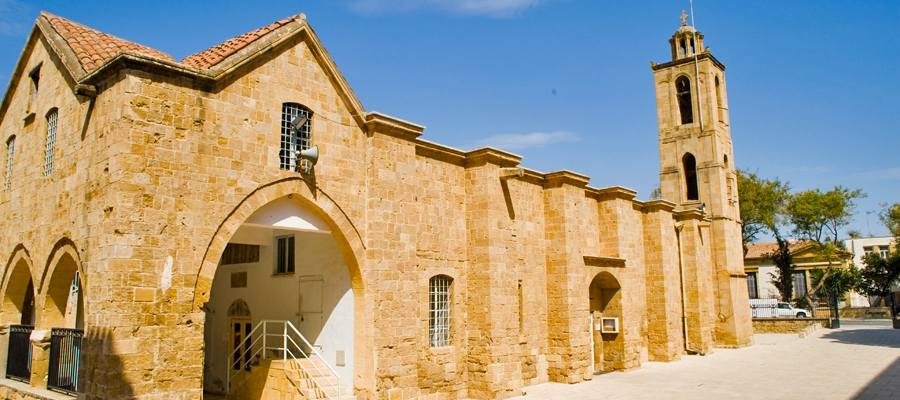
Agios Ioannis (St John’s) Cathedral

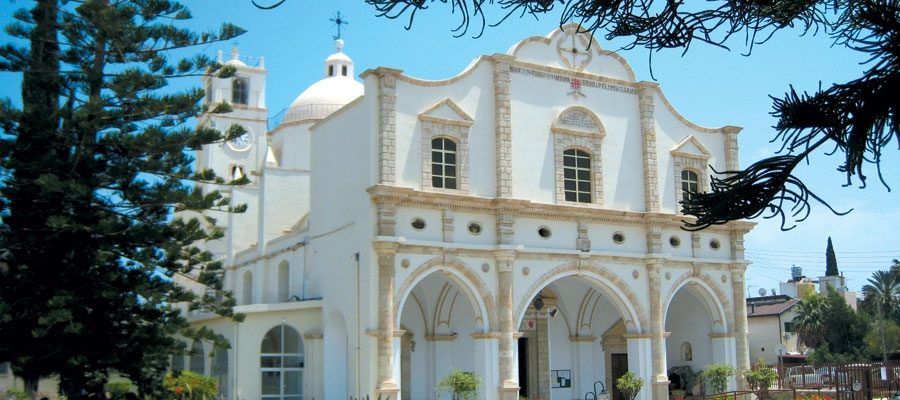
Agios Ioannis, within the walled city of Lefkosia (Nicosia), is built on the site of the 14th century chapel of the Benedictine Abbey of Agios Ioannis, the Evangelist of Bibi.

Archbishop Nikiforos rebuilt the monastery chapel from its foundations in 1662. Dedicated to Agios Ioannis the Theologian, it remained a monastery until the 18th century when Archbishop Sylvester converted it into a cathedral, establishing it as the seat of the Orthodox Archbishopric in Cyprus.

The church is small, single-aisled and barrel vaulted, in the Franco-Byzantine style, with external buttresses and a west portico. In contrast to the deliberately modest exterior that was required by Ottoman rule, the gilded woodwork and bright interior illuminated by crystal chandeliers is particularly ornate. Covered in gold leaf, the woodcarving is in the best tradition of 18th century Cypriot craftsmanship, and it remains the only church in Lefkosia in which the whole of the internal Frescoes have survived in their entirety.

The four large icons on the iconostasis were painted by the Cretan master, Ioannis Kornaros in 1795 and 1797, and the 18th century wall paintings depict scenes from the Bible and the discovery of the tomb of Agios Varnavas (St. Barnabas) at Salamis.

Region: Lefkosia
Address: Plateia Archiepiskopou Kyprianou, (next to the Archbishopric)
Operating Hours: Monday – Friday: 08:00 – 12:00 / 14:00 – 16:00
Saturday: 09:00 – 12:00 (and during mass)
Operating Period: All year round.
Closed on Public Holidays.
Entrance Fee: Free
  Opening and closing times as well as entrance fees, are subject to alterations without notice. Visitors are advised to check before visiting.
 

Kamares Aqueduct

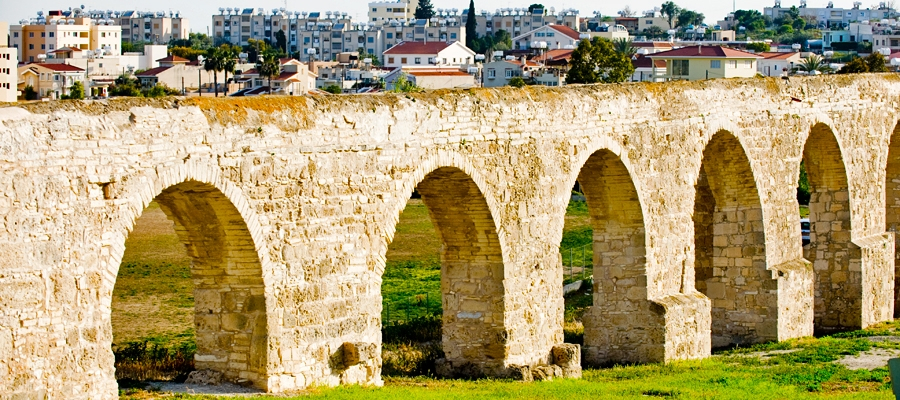
This beautiful 18th century aqueduct can be found on the road heading towards Lemesos (Limassol) in the area of Kamares, which takes its name from the distinctive arches (‘kamares’ in Greek).

An open-air sight, the aqueduct was built in the Roman style in 1746 by the Turkish governor of Larnaka, Bekir Pasha, who funded it out of his own sources to carry water to Larnaka (Larnaca) from a source about 10 km away. The aqueduct was abandoned in 1939 and its function replaced by modern pipes.

There are more than 20 arches still intact, and these are strikingly illuminated at night. A cobbled area with benches and a footpath allow you to enjoy the site of this monument, with the path linking up with Larnaka Salt Lake.

GPS coordinates: Lat: 34.912388 Lon: 33.598903

Agios Georgios Makris Chapel

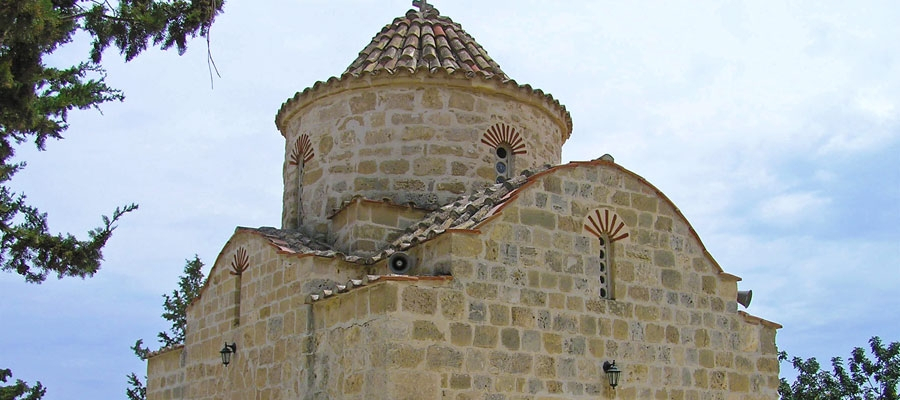
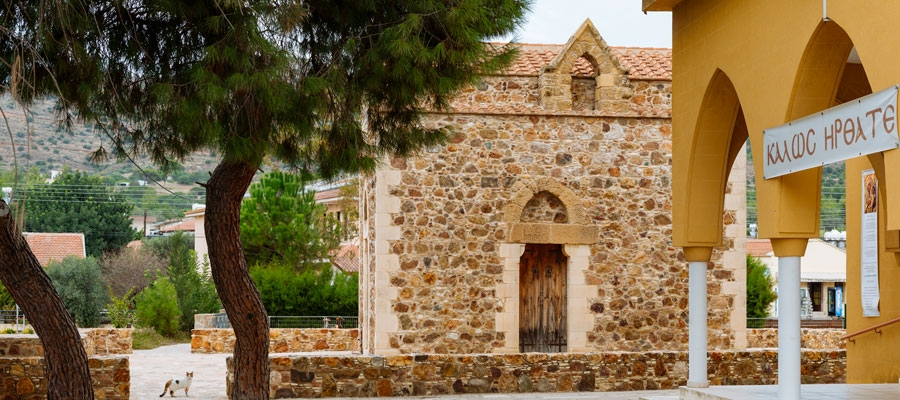
Built on a small hill that overlooks the area of the Salt Lake, the quaint stone-built chapel of Agios Georgios dates back to the 13th century when it was the church of the Medieval village of Agrinou, and serves as a miniature piece of late Byzantine architecture.

The village and the church were destroyed by the Egyptian Mameluks, who invaded in 1426 and also captured the Lusignan King Janos. The church was soon repaired and the king was freed, but an annual tax was paid to the Mameluks until the Ottoman occupation.

The church served as a monastery in the 18th-19th centuries, but the annexed structures were demolished in the 20th century, thus restoring the original setting of the church. A wall painting of the saint still survives on the north wall.

Region: Larnaka (Larnaca)
Address: Faneromenis Avenue
Operating Hours: Church hours.
Operating Period: All year round.
Closed on Public Holidays.
Entrance Fee: Free
  Opening and closing times as well as entrance fees, are subject to alterations without notice. Visitors are advised to check before visiting.
 

Zuhuri Mosque

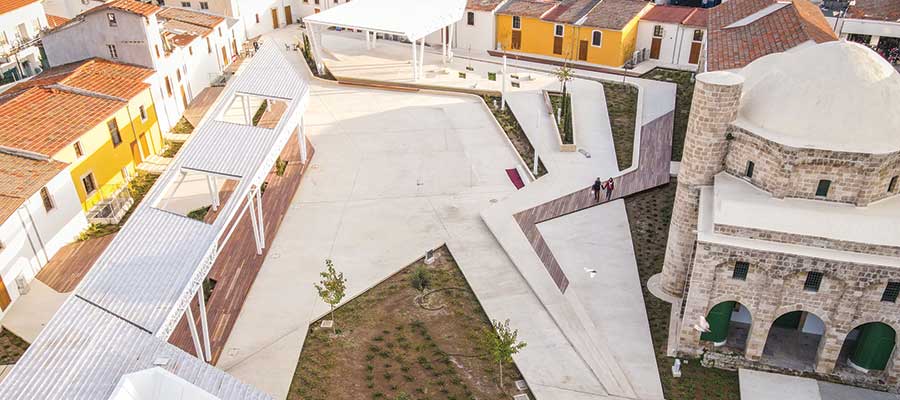
Zuhuri Mosque lies between the Kebir (Buyuk) Mosque and the Church of Agios Lazaros. It was built in the middle of the 19th century and is an important Muslim religious centre. Its minaret collapsed in the 20th century.

Region: Larnaka (Larnaca)
Address: Nicolaou Roussou Street
GPS coordinates: Lat: 34.911776 Lon: 33.636092
Operating Hours: Any reasonable hour providing there is no prayer.
Operating Period: All year round.
Closed on Public Holidays.
Entrance Fee: Free
  Opening and closing times as well as entrance fees, are subject to alterations without notice. Visitors are advised to check before visiting.
 

Tuzla Mosque

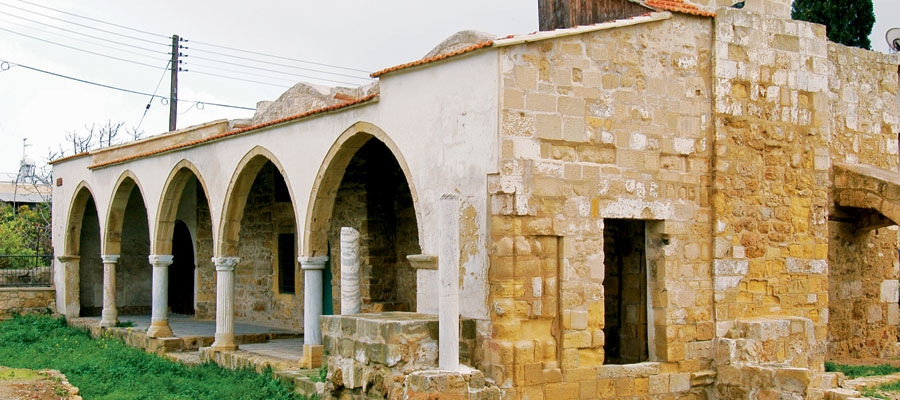
Situated in the old part of town, behind the ruins of ancient Kition, Tuzla Mosque is one of the oldest mosques in Larnaka (Larnaca), and dates back to Byzantine times.

The mosque was originally a Byzantine Orthodox Church, as can be seen by the wall paintings in the building. In the 12th or 13th century it became the Catholic Church of the Holy Cross and was turned into a mosque after the Ottoman occupation of 1571. The minaret is built on the foundations of the original bell tower.

Opposite the mosque is a well-preserved Venetian period public water fountain.

Region: Larnaka
Address: Mitropolitou Nicomedias Street
GPS coordinates: Lat: 34.922414 Lon: 33.623001
Operating Hours: Any reasonable hour providing there is no prayer.
Operating Period: All year round.
Closed on Public Holidays.
Entrance Fee: Free
  Opening and closing times as well as entrance fees, are subject to alterations without notice. Visitors are advised to check before visiting.
 

Terra Santa Catholic Church

Terra Santa is the church of the Latin community of Larnaka (Larnaca) and is also known as Santa Maria delle Grazie. The architectural style of the convent combines impressive Renaissance and Baroque characteristics.

Franciscan monk Callixte Martel founded the church and the convent in 1596, mainly to house Latin pilgrims visiting the Holy Land. In 1724, a larger church and convent replaced the original buildings, which in turn were demolished in 1842 to be replaced by the present church structures.

The Catholic nuns of Italian origin at the convent have a long tradition of philanthropic services to the community of the town. They currently run an old people’s home on the church grounds.

Region: Larnaka
Address: Terra Santa 8
Contact No: Tel: +357 24 642 858
Operating Hours: Church hours.
Operating Period: All year round.
Closed on Public Holidays.
Entrance Fee: Free
Website: www.cypruscatholicchurch.org
  Opening and closing times as well as entrance fees, are subject to alterations without notice. Visitors are advised to check before visiting.
 

Stavrovouni Monastery

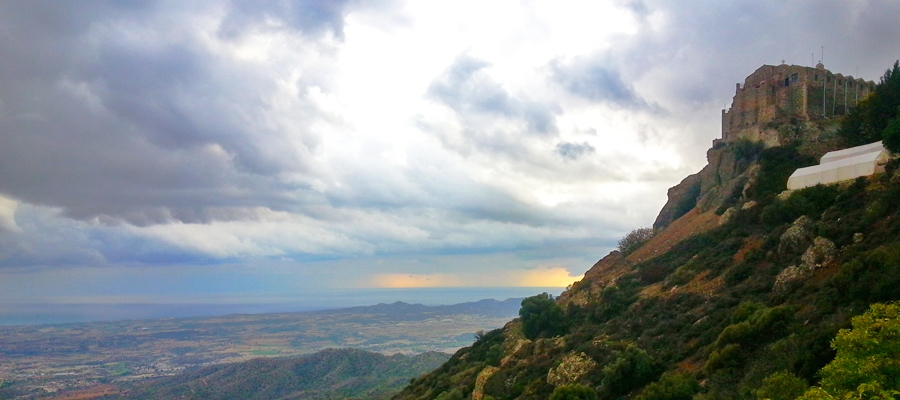
Perched on a rocky peak, 750 metres above sea level, legend tells that Stavrovouni Monastery was founded in the 4th century by St. Helena, mother of Emperor Constantine the Great, who left a relic of the Holy Cross at the monastery.

The monks have strict rules akin to those at Mount Athos in Greece. Women are not permitted to enter the monastery, nor is the use of camera or video permitted. Men visiting must be appropriately dressed.

In contrast, the monastery of Agia Varvara on the foothills of Stavrovouni is accessible to all visitors, and the monks here are known for their iconography skills.

An impressive annual ceremony and festival is held at Stavrovouni Monastery on September 14 to mark the day of the Raising of the Holy Cross.

Region: Larnaka (Larnaca)
Address: 40km from Larnaka, 9km off the Lefkosia (Nicosia) – Lemesos (Limassol) road
GPS coordinates: Lat: 34.886923 Lon: 33.436681
Contact No: Tel: +357 22 533 630
Operating Hours: September – March: 07:00 – 11:00 / 14:00 – 17:00
April – August: 07:00 – 12:00 / 15:00 – 19:00
Operating Period: All year round.
Closed on Public Holidays.
Entrance Fee: Free
  Opening and closing times as well as entrance fees, are subject to alterations without notice. Visitors are advised to check before visiting.
 

Royal Chapel of Agia Aikaterini (St. Catherine) – Pyrga village

Considered to be one of the most interesting surviving structures from the Frankish Period on the island, the Royal Chapel was built in 1421 by the Lusignan King Janus.

The building is a small, single-aisled vaulted structure without an apse. In the past a portico enclosed the chapel on all sides (except for the east side). Up to the end of the 19th century, the ruins of a manor house or a monastery attached to the chapel were visible. Today only traces of these survive.

The chapel was originally entirely painted, but many of the paintings were destroyed during the course of time. On the eastern façade, King Janus is depicted in a wall painting, along with his second wife, Charlotte de Bourbon. The couple are kneeling in front of the Crucifixion cross, whilst another figure kneeling by the feet of Jesus at the scene of the Entombment is believed to be Hugh Lusignan, brother of Janus and Latin Bishop of Nicosia (Lefkosia).

Included in the mural decoration of the chapel is a series of coats-of-arms of the Medieval Kingdom of Cyprus, as well as graffiti carved into the frescoed walls. The graffiti belongs to various pilgrims and travellers, and the dates carved with them fall within the period between the 15th and the 16th centuries.

Region: Larnaka (Larnaca)
Address: Pyrga village, 32km from Larnaka, 35km south of Lefkosia, off the Lefkosia – Lemesos (Limassol) motorway
GPS coordinates: Lat: 34.925522 Lon: 33.431892
Contact No: Tel: +357 96 603 664 (Mr. Antonis Gregoriou)
Operating Hours: September 16 – April 15, Monday – Friday: 08:30 – 16:00
April 16 – September 15, Monday – Friday: 09:30 – 17:00
Operating Period: All year round.
Closed on weekends and on Public Holidays.
Entrance Fee: €2,50
For organised groups consisting of more than 10 persons there is a 20% reduction on the entry fees.
The Department of Antiquities can issue special entry cards for all its museums and ancient monuments: One (1) day entry cards – €8,50, three (3) day entry cards – €17,00, seven (7) day entry cards – €25,00.
Website: www.mcw.gov.cy/da
  Opening and closing times as well as entrance fees, are subject to alterations without notice. Visitors are advised to check before visiting.


Larnaka (Larnaca) Medieval Castle

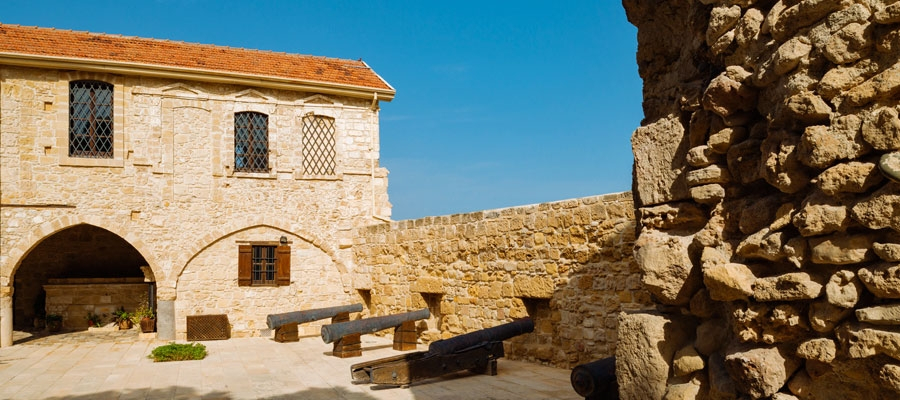
Located at the end of the Foinikoudes promenade, the Medieval Castle of Larnaka (Larnaca) (also referred to as Larnaka Fort) is believed to have been originally built during the Middle Ages, and took its present form during the Ottoman rule, although there is some contestation of its origins.

Chronographer Florius Boustronius dates it to the years of Lusignan King James I (1382 – 1398 AD), who built it to protect the harbour of the town. During the same time, the Genovese occupied Famagusta (Ammochostos) and the Lusignans had to develop another major port for the needs of their kingdom. Sources from the 18th century insist that the castle was built by the Turks in 1625 AD, even though a Turkish garrison was stationed there since 1570 AD. Other references by travellers confirm that the castle was constructed before 1625.

After the end of the Ottoman era in Cyprus, the British converted it into a prison and it was used during the first years of their rule. The western chamber of the ground floor in the east was used for the execution of prisoners. The gallows – which must had been constructed in the room – were in use until 1948.

Today, the castle houses the small Larnaka Medieval Museum across three rooms, and exhibits artefacts from the Early Christian period (4th-7th centuries) to the Ottoman period (18th-19th century).

Region: Larnaka
Address: Leoforos Athinon
Contact No: Tel: +357 24 304 576
Operating Hours: September 16 – April 15, Monday – Friday: 08:00 – 17:00
Saturday and Sunday: 09:30 – 17.00
April 16 – September 15, Monday – Friday: 08:00 – 19:30
Saturday and Sunday: 09:30 – 19.30
Operating Period: All year round.
Closed on Public Holidays.
Entrance Fee: €2,50
For organised groups consisting of more than 10 persons there is a 20% reduction on the entry fees.
The Department of Antiquities can issue special entry cards for all its museums and ancient monuments: One (1) day entry cards – €8,50, three (3) day entry cards – €17,00, seven (7) day entry cards – €25,00.
Pensioners €1,25
Website: www.mcw.gov.cy/da
  Opening and closing times as well as entrance fees, are subject to alterations without notice. Visitors are advised to check before visiting.
 

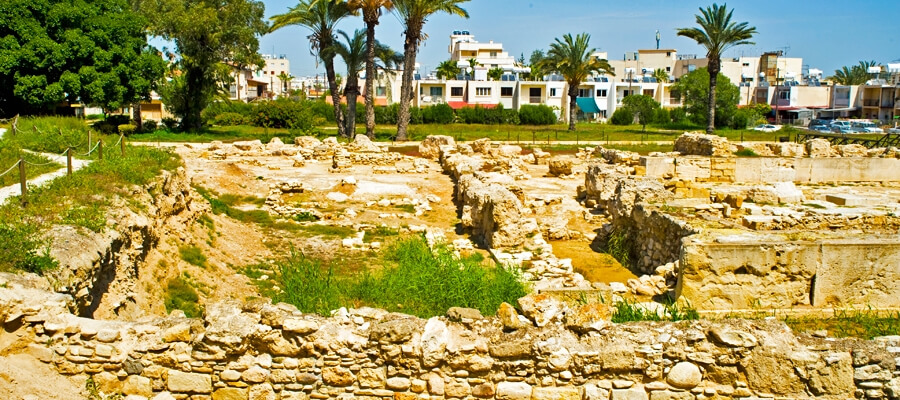
Kition Archaeological Site

The architectural ruins of the ancient city-kingdom of Kition provide the first clear evidence that the Mycenaean Achaeans arrived in Larnaka (Larnaca) in the 13th century BC and stayed until the end of the 11th century BC. The Phoenicians inhabited the city in the 9th century BC.

Around the end of the 13th century, Mycenaean Achaeans fortified the city with cyclopean walls made of giant blocks of limestone. Later on, the Phoenicians settled in the area in the 9th century, and built the temple of Astarte, Goddess of Fertility, related with the worship of Goddess Aphrodite. In 312BC, Kition was originally occupied and then destroyed by Ptolemy 1st Soter (the Egyptian Pharaoh). In spite of this, habitation continued into Christian times.

Kition was well known for its harbour in antiquity, from which many agricultural products were exported to the eastern Mediterranean, Egypt and the Aegean. Moreover, its strategic position rendered it an exceptional naval base. Of particular interest at the ancient port are the drawings of ships etched into the walls of buildings.

The most interesting architectural remains are those of the Temple of Aphrodite-Astarte, built by the same Phoenician masons that built the Temple of Solomon in Jerusalem, both originating in the 9th century BC.

Egyptian-style temples of the 18th Egyptian Dynasty – which are older than their Greek equivalents and served the pre-Hellenic Cypriot population – have also been found nearby.

The site is one of the first that the Cyprus Department of Antiquities excavated, after the island gained its independence from British Rule in the early 1960’s, and is linked to the Aphrodite Cultural Route.

Region: Larnaka
Address: Kition, Leoforos Archiepiskopou Kyprianou
Contact No: Tel: +357 24 304 115
Operating Hours: September 16 – April 15, Monday – Friday: 08:30 – 16:00
April 16 – September 15, Monday – Friday: 09:30 – 17:00
Closed on weekends.
Operating Period: All year round.
Closed on Public Holidays.
Entrance Fee: €2,50
For organised groups consisting of more than 10 persons there is a 20% reduction on the entry fees.
The Department of Antiquities can issue special entry cards for all its museums and ancient monuments: One (1) day entry cards – €8,50, three (3) day entry cards – €17,00, seven (7) day entry cards – €25,00.
Pensioners €1,25
Disabled Access: Wheelchair accessible, disabled parking.
Website: www.mcw.gov.cy/da
  Opening and closing times as well as entrance fees, are subject to alterations without notice. Visitors are advised to check before visiting.