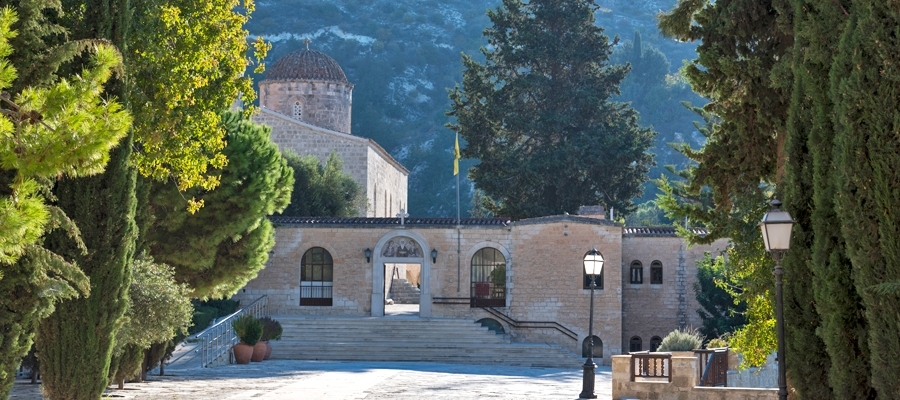
Agios Sozomenos Church

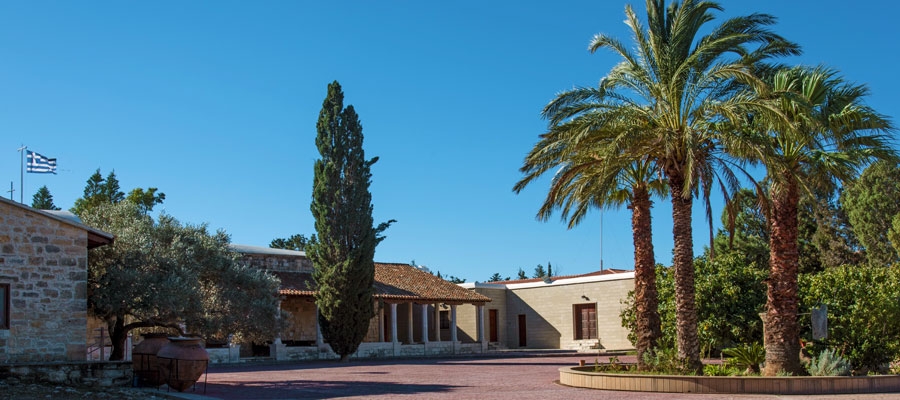
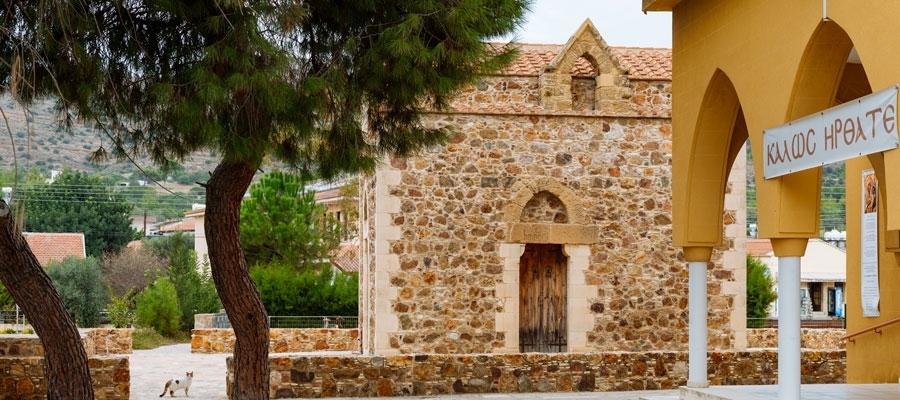
Located in the centre of the mountainous village of Galata, the church of Agios (Saint) Sozomenos dates to the early 16th century and retains a complete series of frescoes in the post-Byzantine style. It is one of four painted churches in the village.

According to an inscription above the west entrance, the church was built and decorated in 1513, and 14 villagers undertook the financial responsibility of painting the church. The structure is aisle-less and timber-roofed, with the roof extending to form a portico in the shape of the Greek letter ‘pi’ (like a square ‘u’).

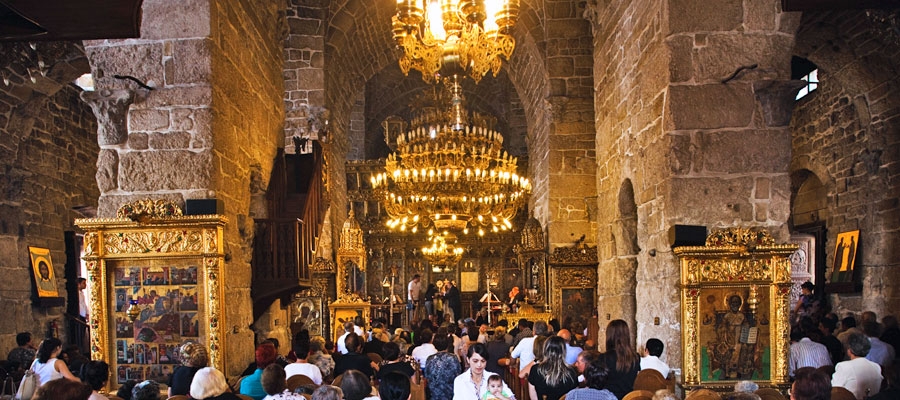
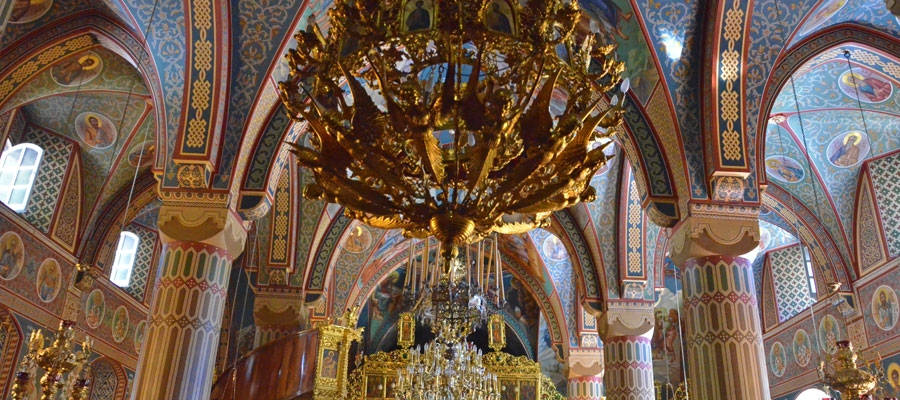
The church’s interior is covered with frescoes that are in generally good condition and are divided into two tiers. On the upper tier there are scenes from the Christological cycle, while on the lower tier the standing figures of saints are depicted under painted arches. In the apse of the bema, the Virgin Mary is shown between the Archangels Michael and Gabriel. The wall paintings on the external side of the north wall include scenes from the Second Coming, the Root of Jesse and the eight Ecumenical Synods.

Region: Troodos area [Lefkosia (Nicosia) district]
Address: Gallata village
GPS coordinates: Lat: 34.996485 Lon: 32.898295
Contact No: Tel: +357 99 671 776
Operating Hours: By appointment.
Operating Period: All year round.
Closed on Public Holidays.
Entrance Fee: Free
Website: www.mcw.gov.cy/da
  Opening and closing times as well as entrance fees, are subject to alterations without notice. Visitors are advised to check before visiting.
 

The Church of the Archangelos Michael, or Panagia Theotokos

Located in the mountainous village of Galata, the Church of the Archangelos Michael, or Panagia Theotokos, is a timber-roofed chapel, painted in the post- Byzantine style of the early 16th century and one of four painted churches in the village.

Region: Troodos area [Lefkosia (Nicosia) district]
Address: Galata village
Contact No: Tel: +357 99 671 776
Operating Hours: By appointment.
Operating Period: All year round.
Closed on Public Holidays.
Entrance Fee: Free
Website: www.mcw.gov.cy/da
  Opening and closing times as well as entrance fees, are subject to alterations without notice. Visitors are advised to check before visiting.
 

Sanctuary of Aphrodite at Palaipafos

The archaeological site of Palaipafos (‘old Pafos’ in Greek) is located in Kouklia Village and was one of the most important city-kingdoms of Cyprus, as well as the first Cypriot site to be included in the World Heritage List of UNESCO in 1980.

The Sanctuary of Aphrodite is the most famous of the Ancient Greek Goddess’ sanctuaries, and its ancient remains date back to the 12th century BC, whilst it remained a place of worship until the 3rd – 4th centuries AD.

There are two versions of how Palaipafos was founded; one story tells that Agapenor, the King of Tegea (Peloponesus), founded the city-kingdom on his way back from the Trojan War. A second legend tells that Kinyras, the local legendary king (12th century) was the founder and first High Priest of The Sanctuary of Aphrodite.

The museum, housed in a Lusignan Manor, exhibits many interesting finds from the area and portrays how the Cult of the Goddess of Fertility developed into the Cult of Aphrodite.

The site is linked to the Aphrodite Cultural Route.

Region: Pafos (Paphos)
Address: Kouklia village, 14km east of Pafos
Contact No: Tel: +357 26 432 155
Operating Hours: April 16 – September 15, daily: 08:30 – 19:30
September 16 – April 15, daily: 08:30 – 17:00
From 1st of July 2024:  Tuesday-Sunday: 8:30-17:00.  On Monday will be closed.
Operating Period: All year round.
Closed on Christmas Day, New Year’s Day and Easter Sunday (Greek Orthodox).
Entrance Fee: €4,50
For organised groups consisting of more than 10 persons there is a 20% reduction on the entry fees.
The Department of Antiquities can issue special entry cards for all its museums and ancient monuments: One (1) day entry cards – €8,50, three (3) day entry cards – €17,00, seven (7) day entry cards – €25,00.
Website: www.mcw.gov.cy/da
  Opening and closing times as well as entrance fees, are subject to alterations without notice. Visitors are advised to check before visiting.
 

Birthplace of Aphrodite – Petra tou Romiou

Aphrodite’s mythical birthplace ‘Petra tou Romiou’ is an interesting geological formation of huge rocks along one of the most beautiful coastlines on the island, located on the southwest coast of the Pafos (Paphos) district.

According to the legend, the Ancient Greek Goddess of Love and Beauty – Aphrodite – was born of the sea foam here. Legend tells that she rose from the waves and was escorted on a shell to this particular beach.

The giant rock formations, which are seen at the same location are linked with another – more recent – legend which tells that the Byzantine hero Digenis Akritas heaved them there to keep the Saracens Arabs (7th-10th centuries) at bay. The name of Petra tou Romiou (‘rock of the Greek’ in Greek) comes from the hero.

It is said that in certain weather conditions, the waves rise, break and form a column of water that dissolves into a pillar of foam. With imagination, this momentarily looks like an ephemeral, evanescent human shape. Other popular myths tell that swimming around the rock three times will bring various blessings, including eternal youth and beauty, good luck, fertility and true love.

The site is linked to the Aphrodite Cultural Route.

Petra tou Romiou – Audio Guide 

Panagia tou Sinti Monastery

The abandoned monastery of Panagia tou Sinti is situated on the banks of the Xeros River in Pentalia, and is dedicated to the Virgin Mary (Panagia) of Sinti.

The church has an octagonal dome with four windows and belongs to the first half of the 16th century. Its central nave is in good condition, and it is considered to be one of the most important buildings of the Venetian period.

The Monastery remained in operation until 1927 and thereafter was abandoned. In 1994, the Monastery of Kykkos undertook the maintenance of the Monastery, completing it in 1997 when it earned the Europa Nostra Award for the use of good restoration techniques and preservation of its original character.  

GPS coordinates: Lat: 34.836407 Lon: 32.639144

Kourion Stadium

Kourion was an important city-kingdom in antiquity and stands as one of the most impressive archaeological sites in Cyprus.

Located 20km west of Lemesos (Limassol), on the road to Pafos (Paphos), Kourion Stadium is the only ancient stadium found in Cyprus. Dating back to the 2nd century, the stadium had a capacity for 6.000 spectators and was the site of pentathlon events in ancient times.

The site is free admission.

Archaeological Site of Kourion – Audio Guide

Agia Anastasia Church

Agia Anastasia Church is a complex of two domed churches located in Polemidia village. The older church – possibly dating to the 12th century – is on the east side and is a cross-in-square domed church. The second church, on the west side, was added in the 14th century and built in the same architectural style. The surviving mural paintings date back to the 14th, 15th and 17th centuries.

Region: Lemesos (Limassol)
Address: Polemidia village, 5km north of Lemesos
GPS coordinates: Lat: 34.700919 Lon: 32.999997
Operating Hours: Any reasonable hour.
Operating Period: All year round.
Closed on Public Holidays.
Entrance Fee: Free
  Opening and closing times as well as entrance fees, are subject to alterations without notice. Visitors are advised to check before visiting.
 

Agios Georgios Alamanos Convent

Located 20km east of Lemesos (Limassol) on the road to Nicosia (Lefkosia), Agios Georgios Alamanos was originally founded as a monastery in the 12th century, and now functions as a convent. Aside from performing their religious duties, the nuns pass their time with icon painting, the cultivation of flowers and herbs, and the production of honey.

Region: Lemesos
Address: South of Pentakomo village
Contact No: Tel: +357 99 541 906, Fax: +357 25 632 788
Operating Hours: Any reasonable hour.
Operating Period: All year round.
Entrance Fee: Free
  Opening and closing times as well as entrance fees, are subject to alterations without notice. Visitors are advised to check before visiting.
 

Church of Panagia Iamatiki

The Church of Panagia Iamatiki is situated on the outskirts of the village of Arakapas, and is a three-aisled wooden-roofed church. The church contains sophisticated wall paintings of the early 16th century that are among the most important surviving examples of the Italo-Byzantine style of art on the island.

An extraordinary leather icon of the Virgin (in the nearby new church) is believed to have special curative powers.

Region: Lemesos (Limassol)
Address: Arakapas village, 35,5km from Lemesos
Contact No: Tel: +357 25 622 300 / +357 25 222 679 / +357 99 411 088
Operating Hours: Old Church: call in advance to arrange a visit.
New Church: any reasonable hour.
Operating Period: All year round.
Entrance Fee: Free
  Opening and closing times as well as entrance fees, are subject to alterations without notice. Visitors are advised to check before visiting.
 

Panagia tis Amasgou Monastery

Located in the Kouris Valley, the small Byzantine church of Panagia tis Amasgou Monastery is dedicated to the Virgin Mary.

The structure is single-aisled and barrel-vaulted with a second timber roof with hook-shaped roof tiles. The original church was built in the 12th century and is adorned with excellent 12th, 13th and 16th century wall paintings. All the surrounding buildings – with the exception of the western wing – are of a later date, and were built to serve the needs of the nuns that recently settled there.

Region: Lemesos (Limassol)
Address: Monagri village, 22,5km north of Lemesos
Contact No: Tel: +357 25 434 342, Fax: +357 25 434 282
Operating Hours: Winter, daily: 07:00 – 12:00 /15:00 – 17:00
Summer, daily: 07:00 – 12:00 / 16:00 – 18:00
Operating Period: All year round.
Entrance Fee: Free
  Opening and closing times as well as entrance fees, are subject to alterations without notice. Visitors are advised to check before visiting.