Kofinou – Larnaka (Larnaca) Cycling Route

This 25km route links the village of Kofinou to Larnaka (Larnaca), and vice versa.

Starting from the village of Kofinou – which is often the start or end of a number of routes – it heads northeast. It travels along the outskirts of the villages of Menogia and Anglisides, passes through the village of Alethriko, reaches the grade­separated junction at Kalo Chorio, and ends at the Fire Department traffic lights in Larnaka town.

Start Point: Kofinou
End Point: Fire Department traffic lights
Total Distance: 25km
Height Gain: 5m
Difficulty Rating: An easy route. Ideal for all types of bicycles with speeds.
Road Conditions: Good quality, paved road throughout.
 

Tour of Deryneia Cycling Route

This 85km route is lengthy ­ but not difficult ­ and passes through some of the most popular beaches of Cyprus as it travels along the coast before returning to Larnaka (Larnaca) via the ‘red soil’ villages (Kokkinochoria) of the Ammochostos (Famagusta) area.

The route begins at Larnaka Tourist Beach and heads east along the coastal road. It turns right at the roundabout just outside the British Sovereign Base Area of Dekeleia, and enters the base. It turns right again at the next roundabout, passes the Dekeleia Power Station and travels along the outskirts of the village of Ormideia. It then turns right again, climbing a little as it passes outside the village of Xylofagou. Heading towards Agia Napa, the route goes past the fishing shelter of Potamos Liopetriou and then Makronissos before travelling along the main Agia Napa ­ Paralimni road.

Thereafter, it turns right on to the road for Cape Gkreko, along a bicycle path on the right­hand side of the road (the side nearest the sea).The turning to Cape Gkreko is 4km down the road to the right. Turning north from Cape Gkreko, the route goes past the Agios Anargyros picnic site and the Konnos area until it reaches Protaras. From Protaras, the route continues to the village of Agia Triada where it turns left towards Paralimni. It then cuts across Paralimni and reaches the road leading to Deryneia after turning right and heading north. From Deryneia the route heads back to Larnaka via the potato­growing villages of Frenaros and Liopetri. After Xylofagou, it follows the same route back.

Start Point: Larnaka Tourist Beach
End Point: Larnaka Tourist Beach
Total Distance: 85km
Height Gain: 260m
Difficulty Rating: An easy route. Requires a street bicycle with speeds.
Road Conditions: Good quality, paved road throughout.
 

Agia Napa – Pyrgos Xylofagou Cycling Route

This 32km route takes the cyclist on a loop from Agia Napa to Xylofagou village, returning along the Xylofagou – Agia Napa road. The route begins at the little harbour of Agia Napa, climbing towards the north, until it reaches the traffic lights where it turns left and to the west, along the bicycle path on the left­hand side of the road. It then continues past Makronissos on the dirt road that leads to the chapel at Agia Thekla and the fishing shelter by Potamos Liopetriou. Heading south, it rounds Cape Pylato the Xylofagou Medieval Tower. From there it takes a northern course to reach the outskirts of Xylofagou, then turns right and to the east on to the Xylofagou – Agia Napa road back to Agia Napa.

Start Point: Agia Napa
End Point: Agia Napa
Total Distance: 32km
Difficulty Rating: An easy route. Requires a 21­-speed mountain bike.
Road Conditions: A variety of surfaces.


Lythrodontas Circular Cycling Route

This 45km route offers some of the most beautiful views that the Machairas Mountains have to offer towards Larnaka (Larnaca) Bay and the Mesaoria plains, with Lefkosia (Nicosia) at the centre, and the Pentadaktylos Mountains in the distance.

The route starts from the central square of the village of Lythrodontas and heads left towards Kyprovasa just outside the village on the road to Machairas, passing through olive groves typical of the area. From Kyprovasa, the course turns to the west towards Profitis Ilias. At the junction ­ with the road leading to Profitis Ilias ­ the route continues to the left, heading south towards Vavatsinia. It is worth stopping here to quench your thirst at the Petris water fountain. After a steady 6km climb, the route reaches the paved Lefkara – Vavatsinia road.

The village of Vavatsinia itself is situated a short distance away to the right. Once inside the village, and after turning right for Machairas, the steep paved road becomes a dirt road. It goes past the Moutti of Pelekanou peak and continues on a relatively flat bit of road until it reaches the Kionia picnic site. After Kionia, the road is downhill for about 10km and leads to the chapel of Agios Onoufrios. From there, the road heads back to Lythrodontas via the picnic site of Mantra tou Kampiou ­ at first paved, but then becoming a dirt track.

Start Point: Lythrodontas
End Point: Lythrodontas
Total Distance: 45km
Height Gain: 890m
Difficulty Rating: A very difficult course with steep uphills and sudden, lengthy descents. Requires a mountain bike with 24 speeds and a front fork suspension.
Road Conditions: A variety of surfaces, with a major part of the route on rough, dirt tracks.


Lefkosia (Nicosia) – Solea Valley Cycling Route

This 165km route passes through the Solea Valley with its traditional architecture and its picturesque Byzantine churches, some of which are on the UNESCO World Heritage List.

The tour follows the same route as that of the Lefkosia (Nicosia) ­ – Adelphoi – Asinou route until it reaches the Kapouras picnic site, from where it takes the alternative route towards Asinou and Agios Theodoros. At Agios Theodoros, the route crosses the main Lefkosia – Troodos road to reach Kato Flasou, where it begins to climb southwards, along the Karkotis riverbank, and through the villages of Evrychou, Tembria, Kaliana, Galata and Kakopetria.

Keeping on the Kakopetria – Prodromos road, the road starts to climb towards the Agios Nikolaos tis Stegis Monastery until it reaches a turning to the right leading to the area of Stavroulia. This part of the road is unpaved and descends in a northerly direction to the Linou – Pedoulas road, offering breathtaking views of Solea Valley and Morfou Bay to the east.

The Pedoulas – Linou road crosses the main Lefkosia – Troodos road and then heads in a north­easterly direction to the village of Koutrafas, situated on the banks of the Elia River. The road then climbs towards the villages of Nikitari and Vyzakia, where it follows the same route back to Lefkosia via Orounta, Kato Moni, Meniko and Palaiometocho, ending at the Agios Mamas grade­ separated junction.

An alternative route to the Koutrafas – Nikitari option is to return to Lefkosia on the main Lefkosia – Troodos road.

Start Point: Agios Mamas grade separated junction
End Point: Agios Mamas grade separated junction
Total Distance: 165km
Difficulty Rating: A difficult route climbing steadily at a 2% gradient on average, and maximum 5%. Requires a mountain bike with at least 21 speeds.
Road Conditions: A variety of surfaces.


Lefkosia (Nicosia) – Pitsylia Cycling Route

This 115km route passes through the beautiful landscape and picturesque villages of the Pitsylia area, famous for its good wine and smoked meat specialities. Although the route is quite long, the section past the village of Alona is downhill all the way to Lefkosia (Nicosia).

The route follows part of the Lefkosia – Machairas route, as far as the village of Episkopi. But from there, it heads west to the village of Arediou instead of on to the village of Politiko, climbing gradually on the old Lefkosia – Palaichori road through Malounta and Klirou, and then turning left towards Fikardou. From Fikardou it goes downhill to Gouri, and then turns right on to the road towards Lazanias and Machairas. Just before Lazanias, the route follows the first dirt road to the right, leading to the village of Farmakas. This dirt road is like a parapet above the cliffs and will give adrenaline addicts a real thrill.

From Farmakas, the route continues south to just above Profitis Ilias at Sykopetra. From there, it follows a paved road to the right and heads west to Palaichori. From the village of Palaichori, the route leads to the Lefkosia – Agros road, turns left and after a short climb turns right to take the road for Askas, Fterikoudi and Alona. There it turns right, heading north, and begins the descent towards Lefkosia. At Alona there is accommodation and restaurants if you wish to spend the night or a few more days in the area.

After leaving Alona, the course descends towards Platanistasa, past the ‘Gefiri tis Panagias’ forestry station, to a right turn leading east to the villages of Mitsero and Agrokipia. From there to the left and south, the route reaches Klirou District Gymnasium. There it turns right just before Arediou to meet the old Lefkosia – Palaichori road, heading back to Lefkosia in the opposite direction.

Alternative route: At Gouri, instead of heading towards Lazanias, take the paved road for Farmakas and Palaichori. Turn right and to the north from Palaichori, and instead of heading towards Askas – Alona, start the descent to Lefkosia.

Start Point: Agios Mamas grade­ separated junction
End Point: Agios Mamas grade­ separated junction
Total Distance: 115km
Height Gain: 1.265m
Difficulty Rating: A fairly difficult course, despite the road being downhill all the way past the village of Alona. Requires a mountain bike with at least 21 speeds. A front fork suspension is recommended.
Road Conditions: A variety of surfaces.
 

Lefkosia (Nicosia) – Asinou Cycling Route

This 83km route takes cyclists from the outskirts of Lefkosia (Nicosia) to the forest of Adelfoi, and past the early Byzantine church of Panagia Forviotissa (Asinou).

The route’s starting point is the junction on the outskirts of Lakatamia where it heads west for about half a kilometre before reaching the Lakatamia bicycle path on the banks of the Pediaios River. The bicycle path ends on Agios Georgios Street, where it turns right and west to reach the traffic lights on the Lefkosia – Palaichori road. Almost exactly opposite the traffic lights lies the road that leads to the village of Agioi Trimithias and onto Palaiometocho and Menoiko.

From Menoiko, the route follows a dirt road before reaching the paved road just outside the village of Kato Moni. From there, Mitsero quarry is visible to the southeast, and the Troodos Mountains to the southwest. From Kato Moni, the route heads north on the Peristerona – Platanistasa road. It climbs for a short distance before turning right towards the village of Agia Marina. From Agia Marina it passes through the village of Agios Georgios, and past the Kapoura picnic site and the villages of Kannavia and Spilia. There is a dirt road at the entrance of Spilia ­ and to the right ­ leading to Asinou and the area where the anti­colonial EOKA movement was most active. The dirt road travels north through the Adelfoi forest for 23km, leading to the Byzantine church of Panagia Forviotissa in Asinou. An alternative road for Asinou is the 9km forest road just after the Kapouras picnic site to the west.

Some 3km along a paved road after Asinou is the village of Nikitari. From there, road signs lead back to Lefkosia through the villages of Vyzakia and Orounta. This part of the road is not paved. From Orounta, the route turns north on to the Peristerona – Platanistasa road towards Kato Moni for the return journey to Lefkosia. An alternative, less complicated route is via Orounta and Peristerona and back to Lefkosia along the main Lefkosia – Morfou road.

Start Point: Agios Mamas grade­ separated junction
End Point: Asinou
Total Distance: 83km
Height Gain: 975m
Difficulty Rating: A difficult route with an average gradient of 2%, but not greater than 5%. Requires a mountain bike with 21 speeds.
Road Conditions: A variety of surfaces.


Authentic Shopping in Cyprus

Whilst Cyprus offers the modern shopping experience you would expect from a European country – with high streets and malls of brand names and independent retailers – the island also retains its traditional shopping allure with unique, locally made items.

With a rich history and many local handicrafts still practised as a speciality in individual villages and regions, you can pick up an authentic piece of the island’s heritage, from intricate lace tablecloths to rustic pottery. And the art of handmade or authentic continues with food and drink, such as painstakingly prepared sweets and delicacies and bottles of olive oil, or the world’s most historic wine.

The island is also popular for its custom-made jewellery and clothing, including gold, leather and tailoring, making it easy and cost-effective to have a one-off created specially to your specifications, taste and personality.

So, whether as a souvenir, a gift for loved ones, or just to treat yourself, there are a multitude of wonderful items you can purchase to take home… the only problem will be deciding what to buy, and how to fit it all in your suitcase!

Traditional Handicrafts

Handicrafts are practised in individual villages where the traditional methods have been handed down from generation to generation, as well as at the island’s Handicraft Centres. Many workshops welcome visitors to observe them in action as they skilfully create in the old, preserved ways, whilst also providing information on the origins and history of the items being made, making them all the more special. You can also find a wide array of folk art at souvenir shops.

Lace: The famous ‘Lefkaritika’ embroidered linens are handmade lace pieces produced in the mountainous Larnaka (Larnaca) village of Lefkara since Venetian times. The linens are made in a very specific way in a process that is both intricate and time-consuming, making them highly prized. You can purchase the highly decorative tablecloths, curtains, placemats and dresser mats at local shops, or they can be made to order for something truly unique. Only lace made in the traditional way is considered to be authentic and is included on the UNESCO Intangible World Heritage List. Legend has it that the famous painter, Leonardo da Vinci himself visited the village in 1481 and bought a lace altar cloth, which he donated to Milan cathedral.

Another form of lace embroidery – that of narrow knit lace – is also practised in many traditional villages, and makes a lovely souvenir to take back home, or as a gift.

Woven goods: The practise of weaving was highly developed during Byzantine times and is still traditionally practised in the Pafos (Paphos) village of Fyti, which makes colourful geometric textured designs on un-dyed cotton cloth – particularly rectangular napkins, tablecloths and bed covers. The pieces can be found in Fyti, as well as in the Handicraft Centres and some souvenir shops.

Pottery: Pottery is a very ancient craft on the island, with the red clay vessels constituting an integral part of daily life in olden times when they were used to store and transport liquids such as wine and water, as well as for the storage of agricultural products. The tradition of pottery making prevails in the villages of Kornos [Larnaka (Larnaca) region] and Foini [Lemesos (Limassol) region], or you can find authentic pieces at the Cyprus Handicraft Centre.

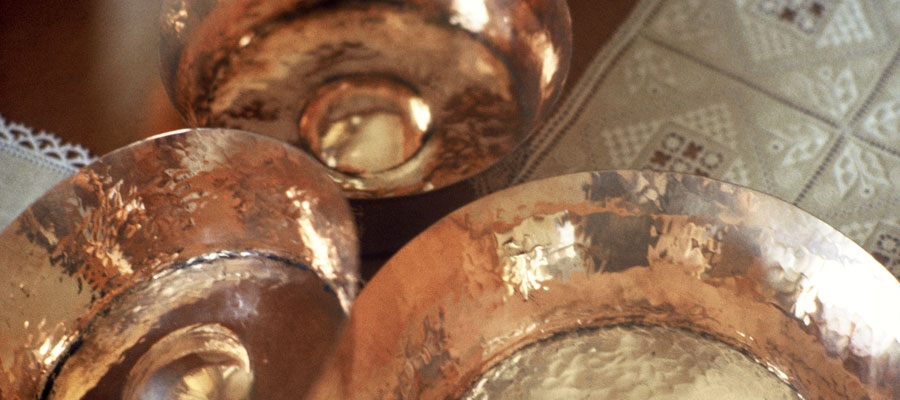
Copperware: Cyprus is traditionally the island of copper, and the base metal was an important export for the island during ancient times. Coppersmiths still make copper pots and kettles today, as well as long-handled pots ‘mbriki’ for ‘cooking’ Cypriot coffee which are available from workshops and souvenir shops. If you are taking back a packet of Cypriot coffee, it is advisable to take a mbriki back too!

Silverware: The art of filigree, known as ‘trifouri’, is a delicate craft that twists fine silver wire into beautiful hand-made jewellery such as earrings, pendants and brooches, as well as decorative cutlery and tableware, with a resulting ‘cobweb’ effect. This traditional craft is still practised mainly in Lefkara, although you can find filigree pieces in jewellery shops and souvenir shops too.

Basketry: Basket making dates from ancient times, when baskets were made to serve a range of specific practical purposes from carrying agricultural produce to dressing bottles to avoid liquids leaking. Baskets are still traditionally made in the Pafos village of Ineia, the Lemesos village of Akrotiri, and the Famagusta villages of Xylotympou and Avgorou, as well as at the Handicraft Centre and other workshops. They come in all shapes and sizes, with the colourful, flat ‘Talari’, most commonly used as a wall decoration in modern times.

Decorated Gourds: The gourd is a vegetable of the marrow family that hangs from a climbing vine and comes in a range of shapes and sizes. The dried vegetable has been decorated and used for practical purposes on the island for many years, with the bottle-shaped gourd the most useful; traditionally used as a wine carafe, candlestick and container for salt or olives. The custom of decorating gourds with geometric patterns or animal and flower motifs is done by knife or with a hot poker, and is still practiced in villages today. Decorated gourds can also be found in souvenir shops.

 

Fashion, Jewellery & Beauty

Feel and look great after a holiday to Cyprus by having something made especially to your measurements or design, or discovering the beauty secrets of Ancient Greek Goddesses! With custom-made available at very reasonable prices, and many establishments offering a quick turnaround time for visitors, you can easily become the proud owner of a piece that will be uniquely yours, and will always remind you of your trip to Cyprus.

Jewellery: The quality of gold and silver in Cyprus is very high, as well as competitively priced. Aside from classic pieces, many jewellers also create seasonal collections relating to the history and customs of the island, including pomegranates, ancient idols, evil eyes (to ward off bad spirits) and sea-themed pieces. Having a custom-made piece of jewellery designed and created to your specifications is also great value, and will leave you with a one-of-a-kind heirloom.

Leather: Leather goods – including bags, wallets, belts, waistcoats, jackets, trousers and skirts – are both high quality and competitively priced on the island. Whilst there are many pieces ready to buy off-the-peg at the island’s dedicated leather shops, visitors can also have something custom-made for an original and distinctive item that is not only tailored to specific requirements, but offers fantastic value.

Tailoring: Many locals have occasion wear tailored for big events – such as weddings and christenings – and as such, seamstresses and tailors have a large selection of fabrics and designs available. Custom-made shirts, three-piece suits, ball gowns and wedding dresses are very competitively priced compared to other countries, and can be made-to-order in a reasonably quick time frame after choosing your fabric and being measured.

Beauty Products: A range of beauty products are made with a number of traditional Cypriot ‘ingredients’ from nature, including donkey milk, olive oil, rose and herbs. Olive oil soap is the most widely available product, whilst other products are more specialised.